A common office scene looks harmless at first. A shelf holds retired laptops, dead phones, old docking stations, and a box of tangled chargers waiting for someone to deal with them later. In practice, that pile can still carry customer files, employee records, saved passwords, or hardware with resale value that disappears once it is treated as scrap.
That is why a search for “e recycling near me” can lead to very different answers. Dropping off a single keyboard at a store is one kind of job. Clearing out business equipment with data on it is another. The first is like taking household batteries to a collection bin. The second is more like transferring records that need a documented chain of custody.
The choice usually comes down to service model. Some options focus on retail drop-off for small quantities. Some retail programs also support business pickups or larger office cleanouts. Some nonprofits and social enterprises accept specific device categories. Full-service IT asset disposition providers handle the heavier work, including pickups, serialized tracking, data destruction, de-installation, and reporting. If you need help sorting those paths, start with these electronics recycling location options and then match the provider to your volume and security needs.
Scale matters too. E-waste keeps growing worldwide, while a large share still does not move through documented recycling channels, as noted earlier in the article. For businesses, that creates two problems at once: avoidable data exposure and missed value recovery.
This guide compares seven real providers through that lens so you can choose the right fit, whether you need a quick consumer drop-off, a business-friendly retail program, a mission-driven donation path, or a certified ITAD partner.
1. Beyond Surplus
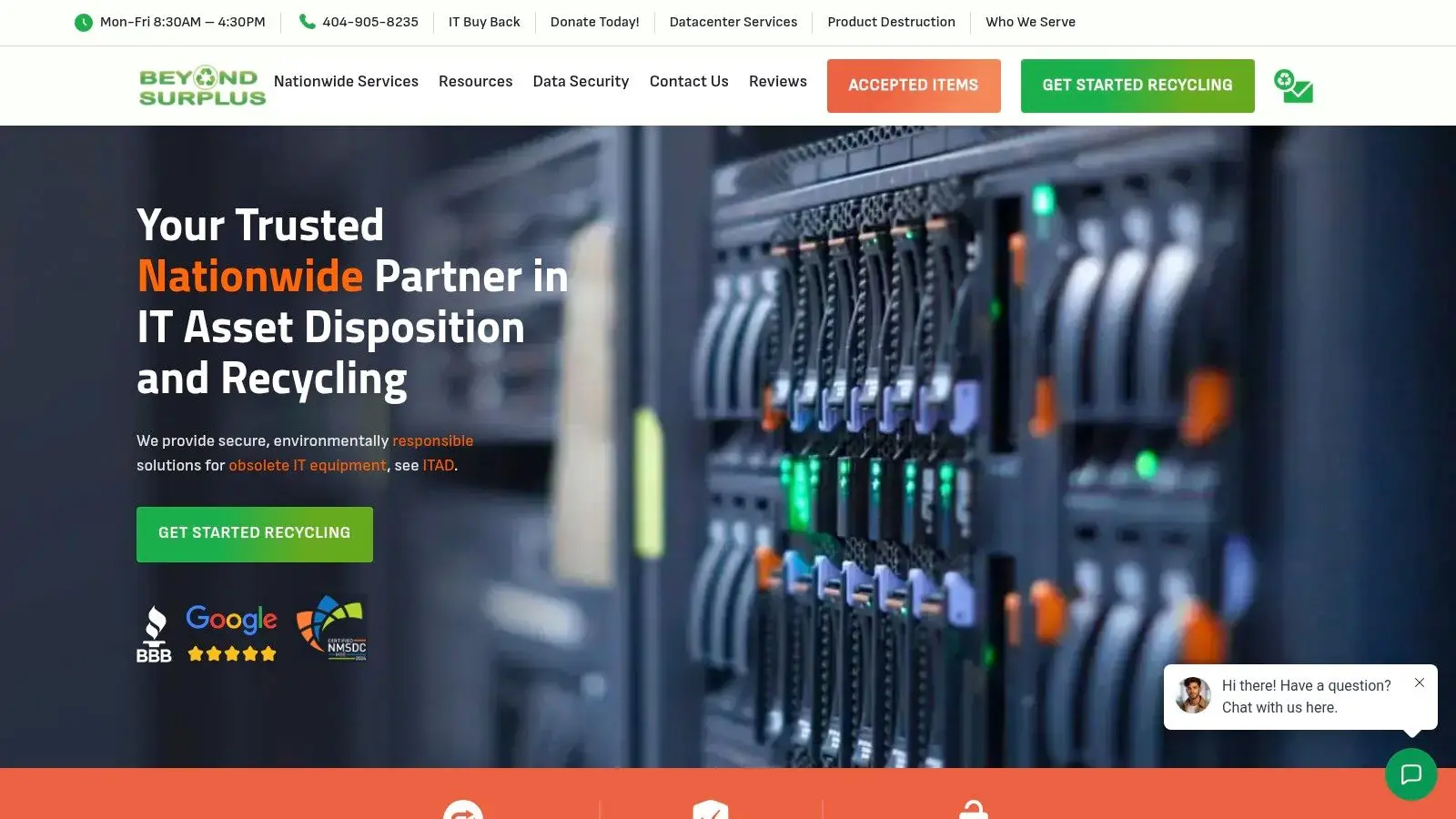
If your search for “e recycling near me” is really about business electronics, Beyond Surplus is the strongest fit on this list. It’s an Atlanta-based IT asset disposition and electronics recycling company that serves organizations across the contiguous United States, with services built around secure data destruction, logistics, and documentation.
Beyond Surplus works well for office relocations, hardware refreshes, warehouse cleanouts, healthcare equipment removal, school surplus, and data center retirement projects. Instead of asking you to carry devices into a store one by one, the company handles pickups, palletized loads, de-installation support, and downstream processing for business equipment.
Why businesses choose it
The biggest difference is chain of custody. Beyond Surplus offers certified data wiping, on-site and off-site hard drive shredding, and certificates of data destruction and recycling. For IT managers, that turns disposal into a documented process instead of a hopeful handoff.
Practical rule: If your company needs proof that assets were destroyed or recycled properly, retail drop-off usually isn’t enough. You need certificates and a documented custody trail.
Beyond Surplus also offers IT buyback and value recovery where equipment still has resale potential. That can change the economics of a large refresh project. Instead of treating everything as waste, you can separate reusable hardware from true end-of-life material.
Best fit and tradeoffs
This is the option to prioritize when you have:
- Multiple assets: Laptops, desktops, servers, networking gear, monitors, and mixed IT loads
- Sensitive data: Drives that require wiping or physical destruction
- Compliance needs: Organizations that need formal documentation for internal audit or regulatory purposes
- Logistics complexity: Multi-site pickups, loading dock coordination, or de-installation work
Residential-style convenience isn’t the point here. Beyond Surplus is built for commercial and enterprise use, so pricing depends on the material, quantity, and pickup scope rather than a posted flat fee.
You can review Beyond Surplus recycling locations and service coverage before requesting a quote, and businesses can submit inventory details for a more accurate plan. If you need one vendor that can handle pickup, destruction, reporting, and potential value recovery, this is the most complete option on the list. Visit Beyond Surplus.
2. Best Buy
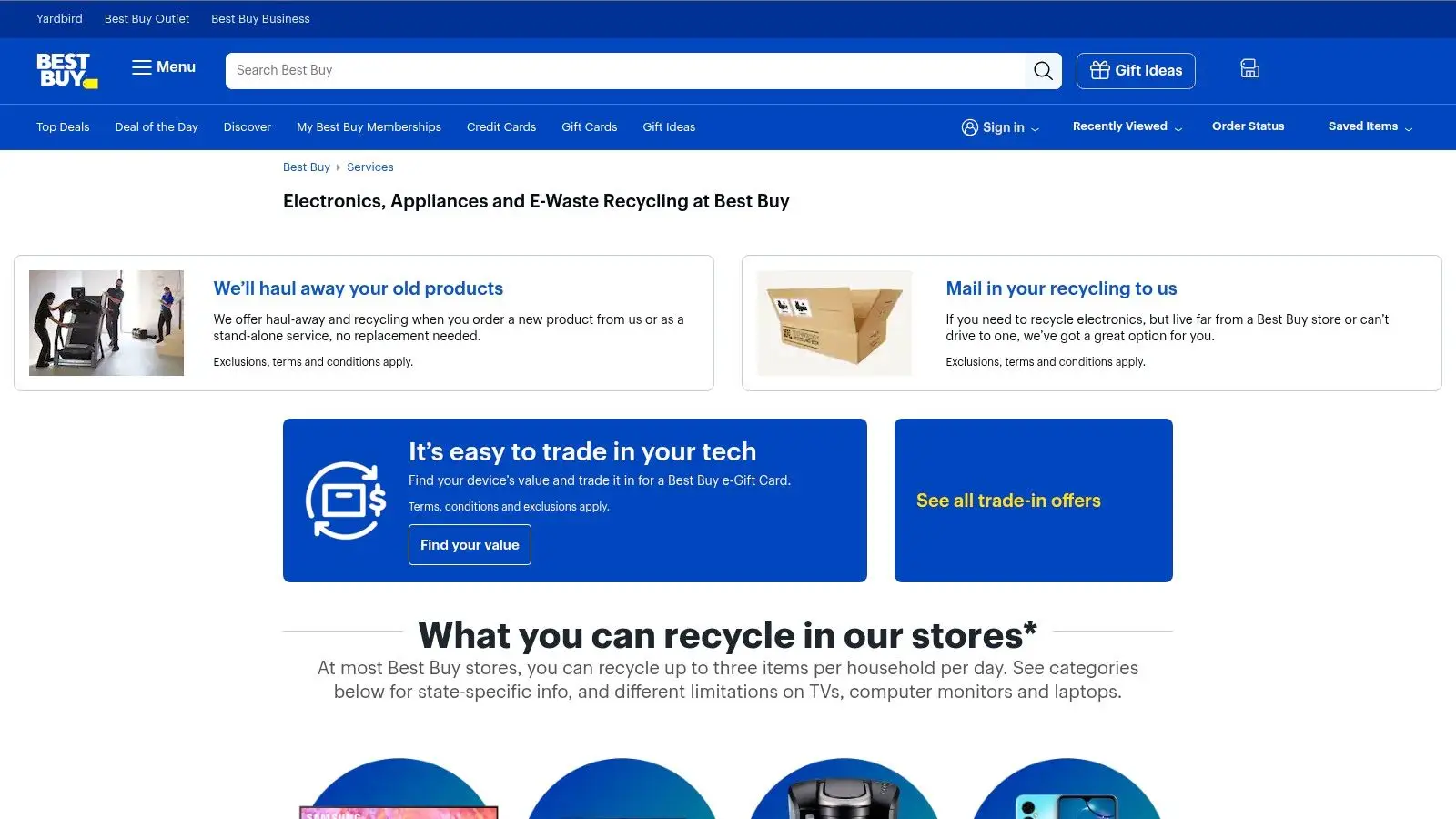
Best Buy is the familiar answer many people find first when they search for “e recycling near me.” That makes sense. It’s easy to find, the process is standardized, and many businesses already buy equipment there.
For a very small office cleanup, Best Buy can be useful. If you’ve got a few keyboards, cables, or aging peripherals and no special documentation needs, retail drop-off is convenient. The company also offers mail-back and haul-away options in some cases, which gives small teams a few different paths.
Where it works well
Best Buy is strongest when convenience matters more than audit detail. A branch office with a handful of low-risk accessories may prefer the speed of a nearby store over scheduling a dedicated pickup.
Still, this model has limits for business users. Retail intake is designed for broad public use, not for serialized asset tracking or formal destruction records. That’s the main dividing line.
- Good for: Small volumes, simple drop-offs, quick cleanouts
- Less ideal for: Servers, storage devices, regulated data, or multi-location projects
- Worth checking first: Item acceptance rules and any local restrictions before loading a vehicle
If you’re comparing retail options against business-grade providers, this breakdown of Best Buy recycling versus ITAD services helps clarify the tradeoffs.
Retail drop-off is convenient. It isn’t the same thing as managed IT asset disposition.
For businesses, that distinction matters most when drives, asset tags, or internal audit records are involved. You can review accepted programs directly at Best Buy Recycling.
3. Staples
Staples fits a different service model than a basic retail counter. It still gives you the convenience of a nearby store, but it also offers mail-in recycling kits that add more structure for small business use.
That distinction matters.
If Best Buy is closer to a quick errand, Staples works more like a small, packaged process. A store drop-off can handle simple items. A mail-in kit can make more sense when a small office, remote employee, or satellite location needs a cleaner handoff than carrying devices into a retail aisle.
What makes it different
The main reason Staples stands out in this list is its middle-ground role. It sits between standard retail drop-off and a full-service certified ITAD provider. For companies sorting through local options for e recycling near me, that can be useful because not every cleanup needs a truck roll, on-site service, or enterprise paperwork.
Its Electronics Recycling Kits are the part business users should look at closely. Those kits are powered by ERI, which adds more process discipline than a casual in-store return. That does not turn Staples into a full asset disposition partner, but it can give smaller teams a more organized path for shipping devices from one location to another.
A simple way to look at it is this: retail drop-off works like tossing a package at the post office counter, while a mail-in kit works more like preparing a labeled shipment with clearer handling from the start.
- Best fit: Small businesses, home offices, remote staff, and branch locations with modest volumes
- Useful for: Mixed electronics, office tech, and situations where mailing items is easier than coordinating a pickup
- Less suited for: Large refresh projects, servers, storage media, or devices that require detailed chain-of-custody records
Store acceptance rules can vary by item and location. Checking your nearest store before loading a car can save a wasted trip.
For households and small companies trying to build a repeatable recycling habit, that practical mix of access and structure is a key advantage. You can review current program details at Staples electronics recycling.
4. Dell Reconnect
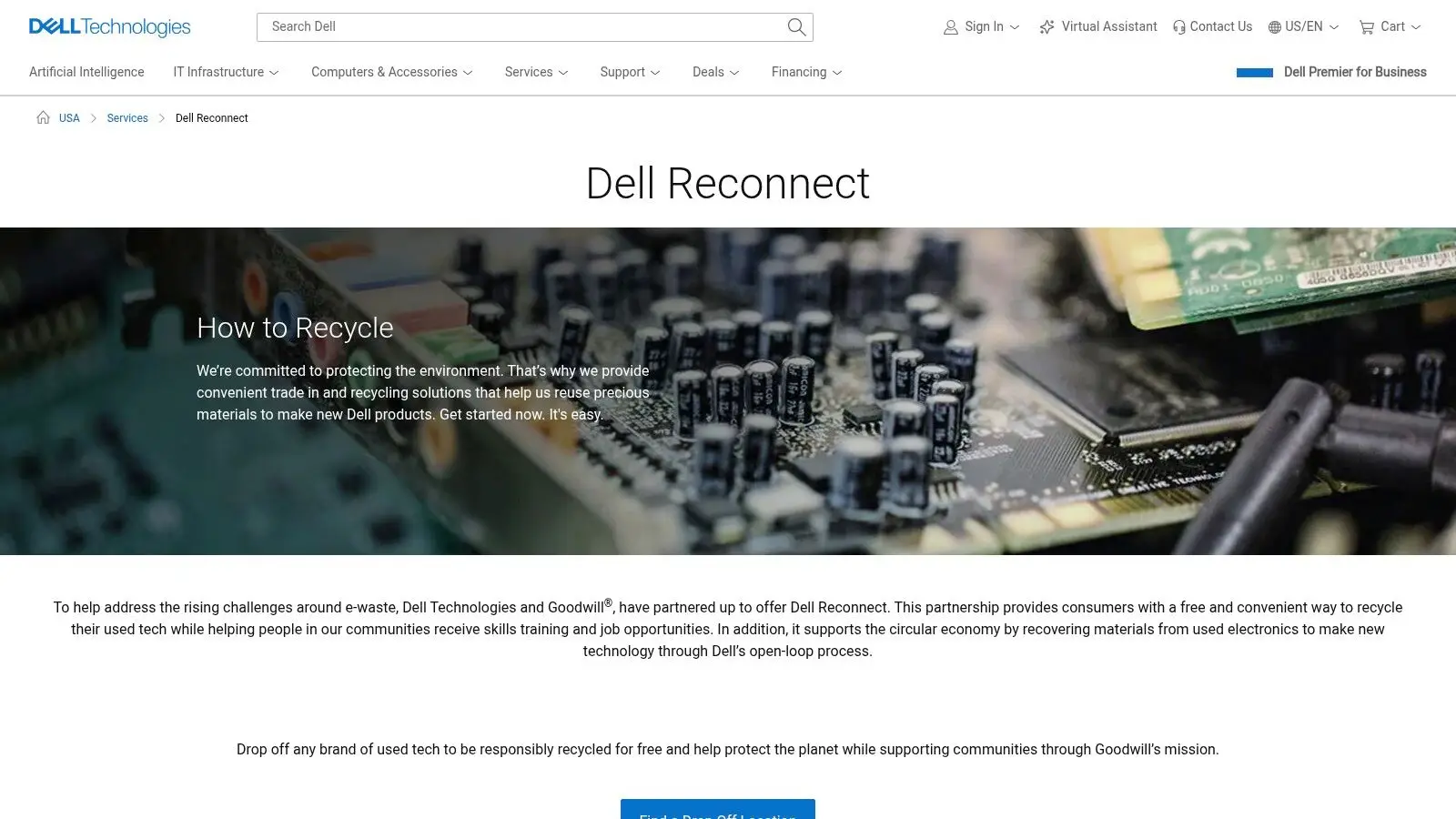
A common local recycling search starts the same way. Someone has an old desktop under a desk, a monitor in a storage room, and a few cables in a box, and they want a nearby place that feels trustworthy. Dell Reconnect fits that moment well.
Dell created the program with Goodwill, which places it in a different category from the retail counters earlier in this list. This is a social enterprise drop-off model. The draw is not just convenience. It is convenience paired with community reuse and recycling channels that many households and small offices already recognize.
That category matters because service model should drive your choice. A social enterprise drop-off site works well for light volumes and simpler items. It is less suited to jobs where your IT or compliance team needs documented custody, serialized reporting, or formal data destruction records.
A useful comparison is this: Dell Reconnect works like taking a donation to a well-known community organization, while a certified ITAD provider works more like checking sensitive assets into a controlled process with paperwork at each handoff.
Best use case
Dell Reconnect makes the most sense for very small quantities of lower-risk equipment from a single location. Examples include an outdated personal computer, a spare keyboard, or a monitor that does not hold company data.
Business users should pause before using it for laptops, drives, or other devices that may still contain sensitive information. Convenience is only one part of good e-recycling. Security and documentation matter too, especially once equipment moves beyond basic peripherals.
The community benefit is still meaningful. Reuse, refurbishment, and responsible recycling support a stronger sustainability story than leaving equipment in a closet or sending it to the trash. For some organizations, that social impact is a real plus. For others, records and controlled handling will outweigh the convenience.
Choose this option when accessibility and community partnership are the priority. Choose a certified ITAD provider when accountability and audit support are the priority.
You can check participating locations and program details at Dell Reconnect.
5. Call2Recycle
Call2Recycle is the specialist on this list. It isn’t trying to be a complete answer for every kind of e-waste. It focuses on batteries and certain device categories, and that focus is exactly why it’s useful.
For businesses, battery disposal is where “e recycling near me” searches often get risky. Teams assume batteries can go with general electronics, then discover packaging, fire safety, and transport rules are different. Call2Recycle helps solve that problem with a broad collection network and dedicated battery handling programs.
Why specialization matters
Batteries need a different workflow than laptops or monitors. They can be damaged in storage, require safer packaging, and often need dedicated return channels. A program built specifically around battery stewardship is easier to trust than a generic drop bin.
This is especially helpful for offices managing:
- Laptop batteries: Spares, swollen batteries, and maintenance stock
- Mobile device batteries: Phones, scanners, handhelds, and accessories
- Mixed battery streams: Small-format batteries from workplace devices and tools
Call2Recycle also supports mail-back solutions and organizational options for more complex battery needs. That makes it a strong companion service even if your company already uses another provider for computers, servers, and networking gear.
North America is a major e-waste market, with the regional market estimated at USD 33.33 billion in 2025 and projected to reach USD 40.51 billion by 2030. Specialized streams like batteries are a big part of why businesses increasingly separate disposal channels by risk type.
If batteries are your biggest immediate headache, start with Call2Recycle.
6. ERI
ERI is an enterprise-scale option. If retail programs feel too light and you need a provider built for larger volumes, multiple locations, and compliance-heavy environments, ERI belongs on your shortlist.
Its strengths are the things IT departments usually ask about first: certifications, data destruction options, logistics, reporting, and downstream process control. ERI also powers Staples’ recycling kits, which tells you something about its role behind the scenes in the U.S. recycling ecosystem.
Where ERI stands out
ERI is better suited to structured corporate projects than casual disposal. Think refresh cycles, national programs, recurring pickups, and asset remarketing workflows. It’s the kind of provider organizations use when disposal has to fit into procurement, security, and compliance processes instead of being handled ad hoc.
That also means the buying process is more formal. You’ll usually work through quotes, scope definitions, and service requirements rather than a simple public drop-off model.
- Strong fit: Enterprise IT, regulated sectors, and multi-site organizations
- Key value: Reporting, destruction documentation, and operational scale
- Less useful for: Small one-off consumer-style drop-offs
Global e-waste volume reached 69.1 million metric tons in 2024, which helps explain why large processors with effective downstream systems matter. Businesses aren’t just discarding machines. They’re navigating a growing material and data security challenge.
You can review ERI’s enterprise services at ERI.
7. Iron Mountain Asset Lifecycle Management
A hospital replaces hundreds of laptops. A law firm retires storage devices tied to client files. In cases like these, the question is not just where the equipment goes. The question is how the organization documents every handoff, every data-destruction step, and the final disposition of each asset.
That is the role Iron Mountain Asset Lifecycle Management fills. In the service-model categories used throughout this list, Iron Mountain sits in the full-service certified ITAD group. It is aimed at organizations that need pickup, chain of custody, data sanitization or shredding, reporting, and records that can stand up to internal audit or regulator review.
Iron Mountain makes the most sense for companies that treat retired electronics as a governed business process, not a one-time cleanout. Its services can fit environments with legal review, procurement controls, privacy obligations, and formal retention policies. That makes it a different choice from retail drop-off or nonprofit collection programs.
Why proof matters as much as pickup
For some organizations, recycling is only one part of the job. The harder part is proving what happened after the devices left the building.
Iron Mountain is often considered for data center closures, healthcare systems, public sector projects, and large enterprises because the paper trail is part of the value. If you are comparing enterprise providers, it helps to understand what R2 certification covers in practice, especially if downstream handling, documented processes, and vendor accountability are on your checklist.
As noted earlier, the e-waste market is large and mature. That matters here because large organizations often need a provider that can process volume while keeping documentation organized and consistent across sites.
For enterprise disposition services, see Iron Mountain Asset Lifecycle Management.
7-Provider E-Waste Recycling Comparison
| Service | Implementation Complexity 🔄 | Resource Requirements ⚡ | Expected Outcomes 📊 | Ideal Use Cases 💡 | Key Advantages ⭐ |
|---|---|---|---|---|---|
| Beyond Surplus | Moderate 🔄, tailored scheduling and on-/off-site work | Business-scale logistics (fleet, pallet min., inventory/photos for quote) ⚡ | Certified data destruction + certificates; value recovery and regulatory support 📊 | Enterprises, data centers, healthcare, finance, schools needing chain-of-custody | Certified destruction, nationwide business pickup, IT buyback, responsive service ⭐ |
| Best Buy | Low 🔄, simple retail drop-off or mail-in options | Low for consumers; store network and haul-away options ⚡ | Convenient recycling and trade-in; no serialized asset certificates 📊 | Households and small offices wanting nationwide convenience | Very broad US coverage and multiple intake channels ⭐ |
| Staples | Low–Medium 🔄, retail drop-off or mail-in kits with options | Store drop-off or mail-in kit (optional serialized certificate via ERI) ⚡ | Retail convenience with optional documented chain-of-custody 📊 | Households and small businesses needing occasional documented disposal | Mail-in kits with optional serialized certificates; ERI partnership ⭐ |
| Dell Reconnect (Dell + Goodwill) | Low 🔄, free drop-off at participating Goodwill sites | Minimal for users; find local participating Goodwill ⚡ | Free recycling and reuse support; no serialized certificates 📊 | Residents preferring charity/community drop-off sites | Free, widely distributed network; social-impact reuse programs ⭐ |
| Call2Recycle | Low 🔄, battery- and cellphone-focused collection | Retail drop-off network + mail-back for bulk/DDR ⚡ | Safe, standardized battery handling with compliance guidance 📊 | Households and organizations collecting batteries or cellphones | Widest battery drop-off network and standardized safety processes ⭐ |
| ERI | High 🔄, enterprise ITAD workflows and audits | Certified facilities, nationwide logistics, quote-based engagements ⚡ | Full compliance reporting, certificates, asset remarketing for large projects 📊 | Large enterprises, regulated industries, multi-site dispositions | Strong certification stack (R2v3, e-Stewards, NAID AAA), enterprise-scale services ⭐ |
| Iron Mountain ALM | High 🔄, structured ALM workflows and SOW-based engagements | Specialized teams, global logistics, higher-cost engagements ⚡ | Auditable end-to-end chain-of-custody and secure data-center decommissioning 📊 | Enterprises and public sector with strict regulatory/security needs | Enterprise-grade compliance, global reach, specialized ALM documentation ⭐ |
Making the Right Choice for Your E-Waste
A good choice starts with one simple question. Are you trying to recycle electronics for convenience, for security, or for both?
That question matters because "e recycling near me" can mean very different service models. A store drop-off bin works well for a dead keyboard, old cables, or a basic home printer. A business retiring laptops, servers, or phones needs something closer to a documented handoff process, where every asset is accounted for and every data-bearing device is handled with care.
The easiest way to choose is to match the provider category to the job:
- Retail drop-off fits small household loads and low-risk items. Best Buy and Staples are often the simplest answer when speed matters more than documentation.
- Retail with B2B services helps businesses that want local convenience plus pickup, reporting, or equipment removal. That model can make sense for offices with recurring disposal needs.
- Social enterprise drop-off works for people who value community reuse programs and accessible locations. Dell Reconnect is a common example.
- Specialized nonprofits are a better fit for narrow waste streams, especially batteries and cellphones. Call2Recycle is built for that specific problem.
- Full-service certified ITAD providers are designed for business risk, larger volumes, and stricter records. ERI and Iron Mountain Asset Lifecycle Management sit in this category.
A practical way to sort your options is to ask three questions before you book anything:
- How sensitive is the data? If a device may hold customer records, employee information, login credentials, or internal files, choose a provider that offers data wiping or destruction and gives you certificates.
- How much equipment is involved? A few household items can go through retail drop-off. Office cleanouts, pallets, and multi-site refreshes usually need pickup, packing, and logistics support.
- What proof will you need later? If legal, compliance, procurement, or audit teams may ask questions, choose a service that documents chain of custody from the start.
This works a lot like choosing shipping. A stamped envelope is fine for a letter. High-value equipment with sensitive data calls for tracked handling, signatures, and records.
For many organizations, that points to a full-service ITAD partner rather than a consumer drop-off program. Beyond Surplus is one example of that model. It offers business pickup, data destruction, certificates of recycling and destruction, de-installation support, and value recovery in one process. Fewer handoffs usually means fewer chances for equipment to be misplaced, undocumented, or left waiting in a back room.
If you are also preparing devices before disposition, this guide on how to factory reset your Android phone safely can help with mobile equipment workflows.
The right answer depends on the item, the data, and the level of accountability you need. Once you sort your options by service model instead of just distance, the choice gets much clearer.
Need a business-ready answer for electronics recycling, IT asset disposition, hard drive destruction, or data center equipment removal? Contact Beyond Surplus for a no-obligation consultation and a secure, documented recycling plan designed for your organization.