
Saturday in Atlanta usually starts the same way. You’ve got a few free hours, the weather is cooperating for once, and someone says, “Should we do the BeltLine?” Then comes the main question. Which part?
That’s where the common understanding often stalls. The atlanta ga beltline isn’t one single experience. It’s a loop of trails, parks, access points, and neighborhoods with very different personalities. Some stretches feel like a rolling street festival. Others are quieter and better for an easy ride, a family walk, or a slower look at the city.
If you’re trying to plan a day that fits your mood, this guide is the local friend version. Not just what the BeltLine is, but how to use it well.
Welcome to the Heart of Atlanta
You step onto the BeltLine with coffee in hand, expecting a nice walk. Ten minutes later, you realize you have stumbled into one of the best ways to read Atlanta. The neighborhoods change block by block. One access point drops you into patios, murals, and people-watching. Another gives you trees, quieter stretches, and room to bike without weaving through a crowd.
That mix is what makes the BeltLine click for first-time visitors. It helps you feel the city at street level instead of seeing it through a windshield. You notice where families start their stroll, where runners pick up speed, and where friends turn a short walk into lunch, a market stop, and sunset photos.
Atlanta’s trail culture also makes more sense once you notice the canopy around you. Even in busy sections, you still get pockets of shade and that familiar green backdrop behind the skyline. It is part of why Atlanta keeps the nickname The City in a Forest.
The helpful way to approach the BeltLine is to match your starting point to the day you want. Food-focused afternoon? Pick an entrance near restaurants and plan short walking hops. Bringing kids? Start where parks and open space are close together. Riding bikes? Choose a segment with longer uninterrupted mileage and easier access to side streets if you want a break.
That is the angle most first-time visitors miss. The BeltLine works less like a single attraction and more like a choose-your-own-route day planner. The best visit usually comes from pairing one trail segment with one nearby neighborhood, then building around that rhythm instead of trying to cover everything.
If your Atlanta plans also include the city’s startup scene, this guide to Atlanta Tech Village in Atlanta GA pairs well with a BeltLine stop nearby.
The Story of the BeltLine From Thesis to Transformation
A lot of first-time visitors assume the BeltLine was built as a scenic place to walk. However, its origins are more interesting. It started as a city-shaping idea, which helps explain why your day here can include a trail, a park, public art, lunch, and three different neighborhoods without ever feeling random.
Where the idea came from
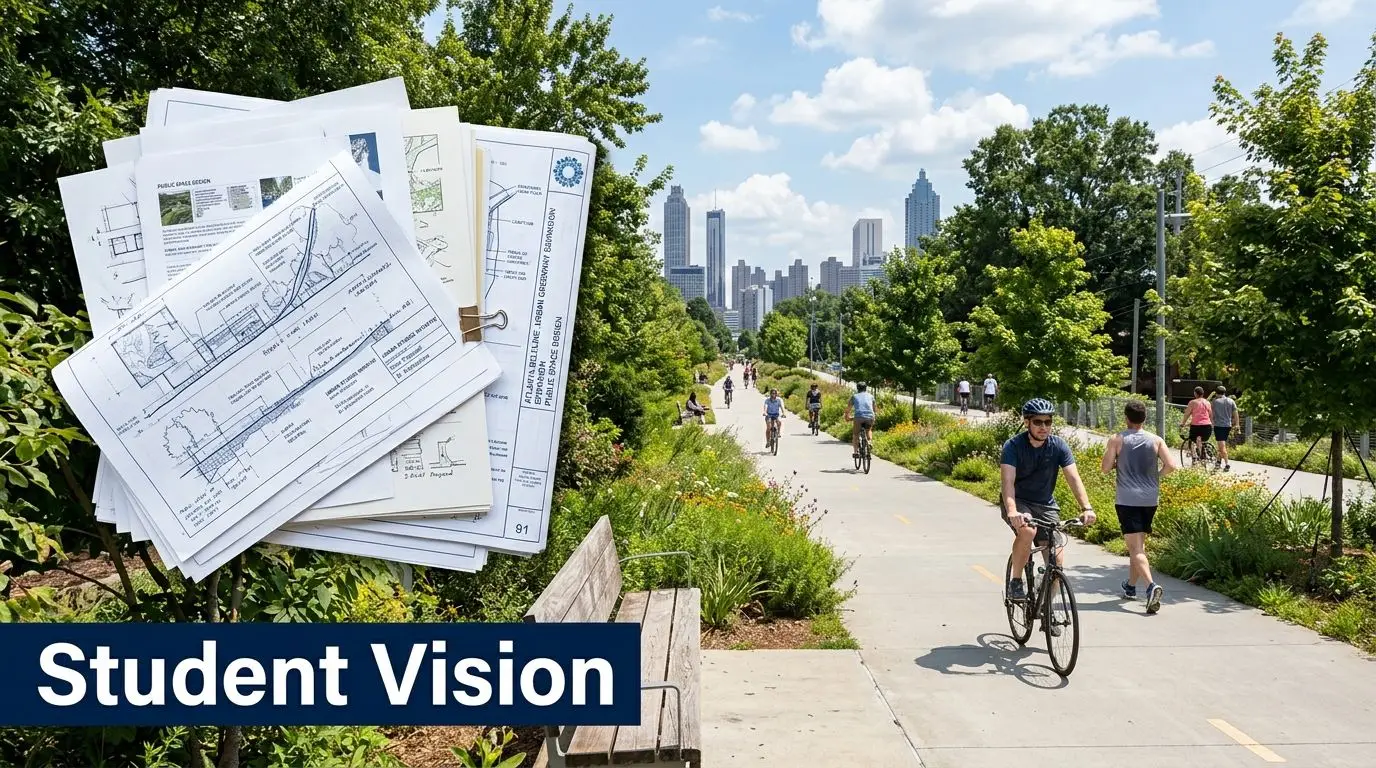
The concept began in 1999 as a Georgia Tech master’s thesis by Ryan Gravel. His idea was simple to say and hard to pull off. Use Atlanta’s old rail corridors to stitch together trails, parks, transit, and neighborhoods that had long felt separated from each other.
That origin matters because it explains the BeltLine’s personality. It works less like a standalone attraction and more like the frame around a full Atlanta day. If you are later choosing between a food-focused afternoon on the Eastside, a family outing near a park, or a longer ride with fewer stops, you are benefiting from that original connected-city vision.
Atlanta already had the physical outline for it. A ring of aging rail lines circled the urban core, and much of that land sat underused for years. The city had a corridor in place. What it needed was a new purpose.
How it became real
A good thesis is one thing. Building miles of public infrastructure is another.
The project moved from concept to official policy in the mid-2000s, when local governments approved the redevelopment plan and set up the BeltLine Tax Allocation District, usually shortened to TAD. If that term sounds technical, here is the plain-English version. The city created a funding tool that could capture some of the future growth in property tax revenue around the corridor and direct it into BeltLine-related improvements.
That funding structure helped turn drawings into visible places people now use every day. Trails opened. Parks took shape. Former industrial edges started becoming front doors for neighborhoods.
Why the project caught on
The BeltLine gained support because it addressed several of Atlanta’s biggest challenges at the same time. It offered a way to add public green space, improve how people move around the city, and reconnect areas that had often been treated as separate islands.
It also reached far beyond the city’s wealthiest blocks. The corridor passes through a wide mix of neighborhoods, including communities that had gone a long time without the same level of investment in parks, mobility, and public gathering space. That broader reach is part of why the BeltLine still sparks strong opinions, strong loyalty, and strong debate.
That debate is part of the story too. Ask a longtime Atlanta resident about the BeltLine and you will hear both excitement and concern. People love the access, the energy, and the new public space. They also care greatly about affordability, displacement, and who gets to benefit as surrounding areas change. If you want to understand the BeltLine clearly, hold both truths at once.
Big picture: The BeltLine succeeds because it combines transportation, public space, redevelopment, and neighborhood connection in one shared corridor.
Today, well-known pieces such as the Eastside Trail, Westside Trail, Historic Fourth Ward Park, and D.H. Stanton Park give you a visible sense of how far the project has come. The larger loop is still a work in progress, which is another helpful thing for visitors to know. You are not showing up to one finished attraction. You are stepping into an Atlanta project that is still being built, neighborhood by neighborhood, segment by segment.
Exploring the Loop A Segment-by-Segment Breakdown
Saying you “did the BeltLine” is a little like saying you “saw Atlanta” in one afternoon. You probably experienced one slice of it, and that is the right way to start.
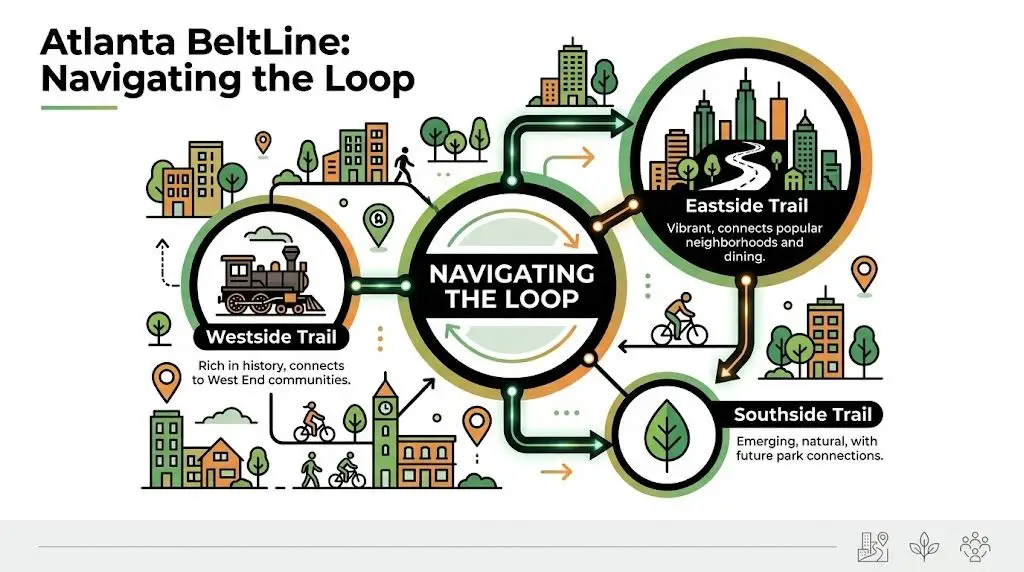
The BeltLine makes more sense once you stop treating it like one uniform loop. Each segment has its own pace, crowd pattern, and best use. If you know that before you go, planning gets much easier. It also helps you match the trail to the kind of day you want, whether that means patio hopping, riding for miles, or keeping kids happy without a long detour.
Atlanta BeltLine trails at a glance 2026
| Trail Segment | Length (approx.) | Surface | Vibe & Crowds | Key Highlights |
|---|---|---|---|---|
| Eastside Trail | 2.25 miles | Concrete | Busy, social, high-energy | Popular access to major dining and park areas |
| Westside Trail | Longer-feeling route with multiple access experiences | Paved trail and connected sections | More relaxed, community-focused | Historic neighborhoods, art, skyline moments |
| Southside Trail | Expanding corridor | Mix of completed and developing sections | Emerging, less predictable | Future connections and park access |
Eastside Trail
For a first visit, Eastside is usually the easiest place to begin. It is the most recognizable section, the most active, and the simplest to read as you walk. If your group wants cafés, people-watching, public art, and plenty of places to pause without much planning, this is the segment that delivers.
The design explains why it feels so usable. According to Atlanta BeltLine design and construction updates from June 2025, the Eastside Trail is 2.25 miles long and built with a 14-foot-wide concrete path that has a slip-resistant finish, with materials chosen for heavy long-term use. On a crowded Saturday, that extra width matters. Walkers, runners, bikes, dogs, and strollers all share the same corridor, so a trail that feels roomy on paper feels much better in real life.
Eastside works best for short, stop-filled outings. If your ideal BeltLine day includes snacks, murals, and easy access to nearby attractions, start here and keep your mileage expectations modest.
Westside Trail
Westside has a different rhythm. The crowds usually thin out, the spacing opens up, and the experience feels better suited to people who want to keep moving instead of stopping every few minutes.
That makes Westside a smart pick for cyclists, longer walks, and repeat visitors who want a broader view of Atlanta beyond the most photographed stretch. You still get art and neighborhood character, but the mood is calmer and more local. If Eastside feels like a lively front porch, Westside feels more like a long neighborhood greenway where you can settle into a steady pace.
Westside is also the segment I recommend to visitors pairing the BeltLine with a larger sports or entertainment day. If you are building out a full Atlanta itinerary, this guide to the Atlanta Braves area and nearby attractions can help you connect your trail time with the rest of the city.
A simple rule helps here. Choose Eastside for browsing. Choose Westside for covering ground.
Southside and the developing sections
Southside is the part that confuses first-timers most often, because it includes a mix of completed trail, newer connections, and areas still taking shape. The experience can change more from one access point to another than it does on Eastside or Westside.
That does not make it less worthwhile. It just means Southside rewards a little homework. Check current access before you go, pay attention to which parks or neighborhood entries you want to use, and expect a more evolving feel than a polished, destination-heavy stroll.
For Atlanta locals, Southside shows the BeltLine as an active city-building project. For visitors, it is best approached with a specific plan instead of a vague idea that you will “see the whole loop.”
A simple way to choose your segment:
- Want the classic first visit? Pick Eastside.
- Want a ride or walk with more breathing room? Pick Westside.
- Want to see where the project is growing next? Choose Southside, then confirm access points before you leave home.
Planning Your Perfect BeltLine Day Curated Itineraries
The BeltLine works best when you stop trying to “see everything.” Pick a theme. Atlanta rewards that approach.

Food and art explorer
Start on the Eastside with a plan to walk, not rush. This is the itinerary for people who like stopping often and letting the day stretch out.
A good rhythm looks like this:
- Start late morning so cafés, markets, and patios are fully awake
- Walk in short bursts and leave time for murals, side streets, and people-watching
- End with a long meal or drinks instead of trying to rack up mileage
This route fits visitors who want the social version of Atlanta. If your group also follows local sports and entertainment zones, this guide to the Atlanta Braves area can help you connect the BeltLine to a bigger day in the city.
Westside explorer ride
Cyclists usually enjoy Westside more because the experience can feel steadier. You spend less time negotiating the densest crowd patterns and more time riding.
Bring water, check your bike before heading out, and be ready to pause for photos rather than trying to treat it like a race route. The BeltLine is shared space first.
Stress-free family afternoon
Families do best when the day has one anchor. Historic Fourth Ward Park is a great anchor because it gives kids room to move and adults a place to reset before deciding whether to add more walking.
A family BeltLine day goes better when the park is the destination and the trail is the bonus.
Keep your route flexible. If the kids are happy, keep going. If they’re done, you’ve already had a good outing.
Getting There and Around Parking Transit and Access
Your BeltLine day usually succeeds or fails before the first step. Start with access, not ambition.
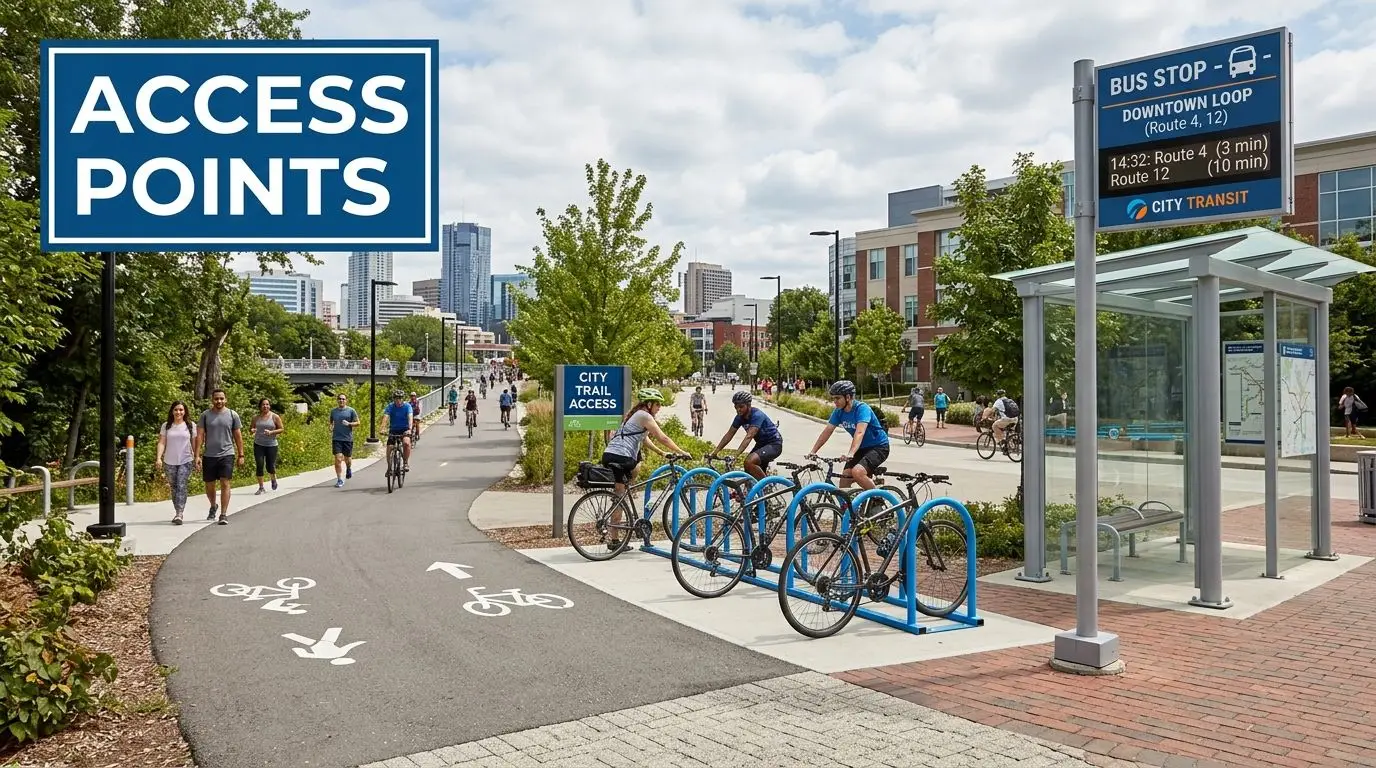
Choosing your entry point
For most first visits, it’s smarter to choose a neighborhood or destination, then enter the trail there. If you start by searching “BeltLine parking,” you’ll often end up with a vague plan and a longer walk than you expected.
Use this rule of thumb:
- Eastside entry if your priority is food, markets, and the highest-energy trail section
- Westside entry if you want easier pacing and a less packed experience
- Park-based entry if kids, strollers, or a casual walk are the focus
MARTA and the future transit vision
Public transit is part of the long game for the BeltLine itself. For the integrated transit system, planners selected Streetcar technology over light rail because of lower capital costs, lower noise impact at 55-65 dBA compared with 70-80 dBA for light rail, and a better ability to handle tight curves in the historic corridor, according to the Tier 1 Final Environmental Impact Statement.
That sounds technical, but the takeaway is simple. The corridor has physical constraints, and streetcar fit those realities better.
If you’re arriving through the region’s main travel hub and planning a car-free Atlanta day, this local guide to Hartsfield-Jackson Atlanta International Airport is a useful next step.
Parking strategy that saves frustration
Atlanta locals know this already. The best parking move is often to arrive earlier than feels necessary, especially for Eastside plans.
A few practical habits help:
- Pick one primary lot or deck and one backup before you leave home
- Expect busy weekends near the most popular entrances
- Don’t overcommit to one long one-way route unless your return plan is clear
Beyond the Path Art Events and Local Amenities
A first-time BeltLine visit often starts with a walk and turns into a full day. You head out for a mile or two, then a mural stops you, live music pulls you toward a patio, and suddenly the trail feels less like a route and more like a string of neighborhood living rooms.
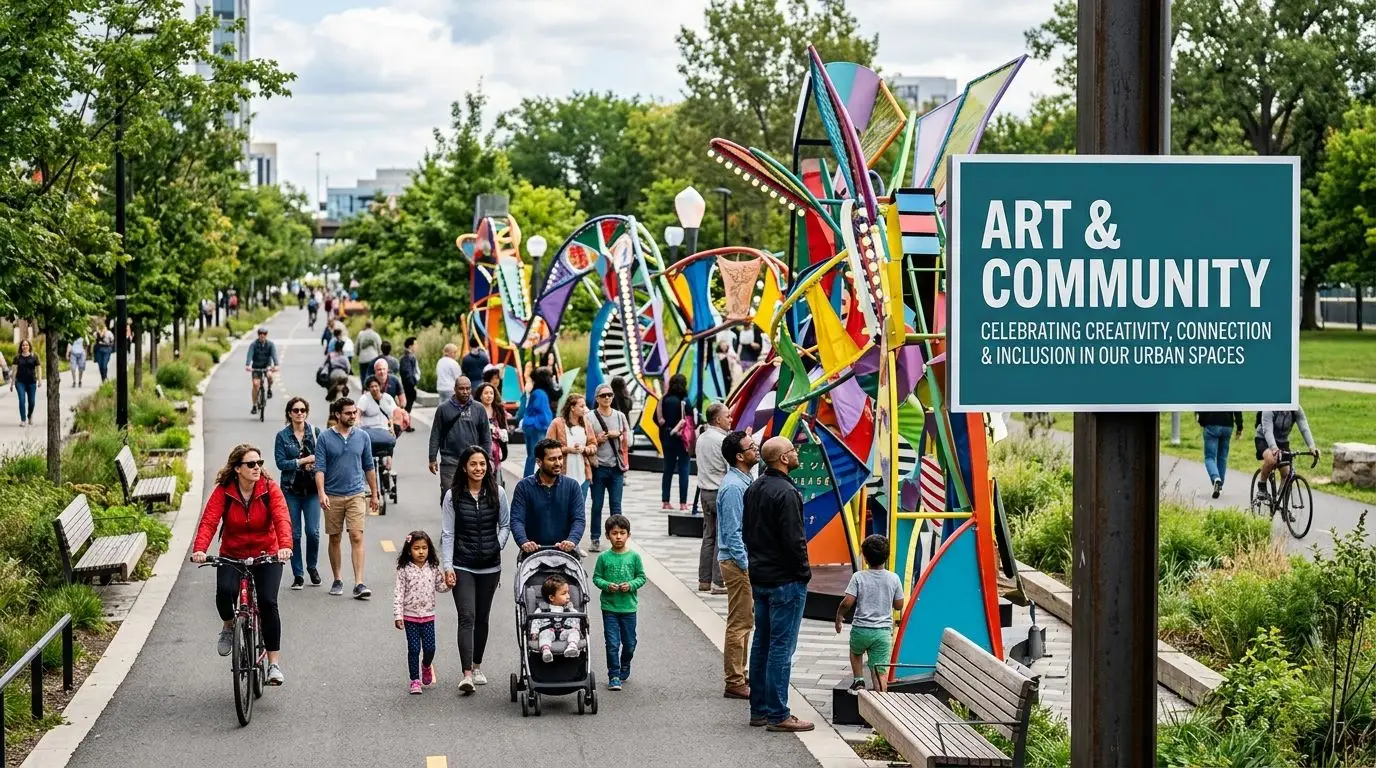
Why the trail feels bigger than a trail
The BeltLine works like a spine for nearby neighborhoods. The path gives people a reason to show up on foot or by bike, and local businesses gather around that steady flow of visitors. As noted earlier, the project has shaped investment patterns across Atlanta, but what you notice as a visitor is simpler. More places to pause. More reasons to stay out longer. More ways to build a day that fits your group.
That matters if you are planning one of the themed itineraries in this guide. A foodie day gets better when you know where the patios and snack stops cluster. A family outing improves when restrooms, treats, and open spaces are close together. A bike-focused day is smoother when you pair a longer ride with a coffee stop or lunch spot near your exit point.
Art and events that can reshape your route
Public art is one of the BeltLine’s best surprises. Some pieces are large and obvious. Others are the kind you catch out of the corner of your eye, which makes repeat visits feel different even if you use the same segment twice.
Events change the rhythm too. On a quiet morning, the BeltLine can feel like a neighborhood shortcut with great scenery. During markets, pop-ups, or performance-heavy weekends, it feels more like a moving festival. If you prefer a calmer experience, go with a looser plan and leave time to stop without rushing your whole route.
A practical way to use that. Pick your segment first, then add one nearby attraction rather than stacking too much into the day. For example, families may want a shorter walk with art-spotting built in. Food-focused groups can start on a busier section where grabbing drinks or dessert is easy. Bikers usually have the most fun when they treat art stops as quick breaks, not the main event.
Local amenities that make the day easier
The smallest conveniences often shape the visit more than the headline attractions. Water, shaded seating, coffee, ice cream, and an easy restroom stop can rescue a day that starts getting wobbly, especially with kids or out-of-town guests.
That is why the BeltLine works best as a choose-your-own-day experience, not a checklist.
Look for amenities in clusters near your access point and use them as anchors:
- Casual food stops for a flexible lunch instead of a fixed reservation
- Coffee shops and dessert spots for a mid-walk reset
- Breweries, patios, and gathering spaces if your group wants to linger
- Parks and open areas nearby when kids need room to move beyond the trail itself
The BeltLine also ties into Atlanta’s wider event rhythm. If your plans line up with a game day or you want to connect your walk with stadium-area energy later on, this Atlanta Falcons area guide can help you map that out without wasting time crisscrossing the city.
Insider Tips for a Safe and Accessible Visit
The smartest BeltLine visitors don’t just pick a segment. They pick a time, a pace, and a backup plan.
Crowds change the experience more than distance does. If you want space, go earlier. If you like energy, late morning into afternoon often feels livelier. Evening walks can be great, but check lighting, stay aware of who’s around you, and keep your route simple if you’re unfamiliar with the area.
Trail etiquette that makes the day better
Shared-use trails work when everyone acts like they’re sharing them. Keep right when you’re moving slowly, avoid sudden stops in the middle of the path, and give clear notice before passing.
If you’re with a group, don’t spread across the full width. That one habit causes more awkward weaving than almost anything else.
Accessibility and resilience matter
The BeltLine is often praised for connecting 45 neighborhoods, but there’s another side to good planning. Research has identified parts of its network of bridges and tunnels as “vulnerable critical facilities,” pointing to the need for emergency risk assessments and long-term resilience planning, as noted by the World Resources Institute discussion of the Atlanta BeltLine.
That may sound distant from a casual visit, but it isn’t. Good public space depends on maintenance, emergency access, and thoughtful design. It’s one reason accessible entrances, clear wayfinding, and well-managed infrastructure matter so much.
If you’re coordinating Atlanta travel around flights, meetings, or facility visits, this related guide to Atlanta Hartsfield-Jackson Atlanta International Airport can help simplify the larger logistics.
Practical rule: Pick the BeltLine section that matches your group’s patience, not just their interests.
If your Atlanta organization also needs secure, compliant technology disposition, contact Beyond Surplus for certified electronics recycling, IT asset disposal, data destruction, and business pickup services.