In today's complex regulatory environment, managing the vendors responsible for your IT asset disposition (ITAD) and electronics recycling is more than an operational task; it's a critical component of corporate risk management and data security for businesses in Atlanta, Georgia. The right partner protects your sensitive data, ensures environmental compliance, and maximizes value recovery from retired assets. Conversely, the wrong vendor can expose your organization to devastating financial penalties, data breaches, and lasting reputational damage. Strong vendor management best practices are the foundation of a secure and efficient ITAD program.
This comprehensive guide moves beyond generic advice to provide a strategic framework for IT directors, procurement professionals, and business owners in Atlanta, Georgia. We will detail 10 essential best practices designed to build resilient and cost-effective vendor partnerships. For a comprehensive look at improving your vendor relationships, consider implementing these actionable vendor management best practices to establish a solid governance model.
From initial procurement and contract negotiation to ongoing performance audits and compliance verification, these insights are designed to be immediately implemented. You will learn how to:
- Establish robust security and data destruction controls.
- Define clear Service Level Agreements (SLAs) and Key Performance Indicators (KPIs).
- Ensure supply chain transparency with meticulous chain-of-custody documentation.
- Optimize value recovery and manage program costs effectively.
By applying these principles, you can transform your organization's ITAD process from a potential liability into a strategic asset, safeguarding your company's interests at every stage of the equipment lifecycle.
1. Vendor Selection and Qualification Framework
Effective vendor management best practices begin long before a contract is signed. The foundation is a systematic vendor selection and qualification framework, a structured process for evaluating and choosing ITAD and electronics recycling partners. This framework moves beyond simple cost comparisons to a risk-based assessment, ensuring your chosen vendor can meet stringent requirements for data security, environmental compliance, and legal liability transfer.

A robust framework prevents partnerships with unqualified vendors that could expose your organization to data breaches, environmental fines, or reputational damage. It forces a clear definition of needs and priorities, which then become the measuring stick for all potential partners. For example, a healthcare system in Atlanta must prioritize HIPAA compliance when disposing of medical equipment, while a local financial institution will focus on vendors demonstrating PCI-DSS compliance for hard drive destruction.
Actionable Tips for Implementation:
- Develop a Weighted Scorecard: Create a vendor evaluation matrix with predefined criteria. Assign higher weight to non-negotiable items like data destruction standards and environmental certifications (R2, e-Stewards).
- Verify, Don't Just Trust: Request and independently verify all certifications. Check their status and scope directly with the certifying bodies. Don't rely solely on a logo on a vendor's website.
- Conduct On-Site Audits: Before finalizing a contract, tour the vendor’s facility. This provides firsthand insight into their security protocols, sorting processes, and operational integrity that documents alone cannot convey.
- Check Industry-Specific References: Ask for references from organizations within your sector. A vendor’s experience with a company facing similar compliance and security challenges is far more valuable than a generic testimonial.
Key Takeaway: Document every step of your qualification process. Creating a clear audit trail for why a specific vendor was chosen (or rejected) is critical for demonstrating due diligence during internal or external compliance audits. Selecting a partner that aligns with your corporate responsibility goals is also a key part of this process; you can learn more about choosing an ESG recycling partner to strengthen your framework.
2. Service Level Agreement (SLA) Development and Management
While a good vendor selection process sets the stage, the Service Level Agreement (SLA) codifies the relationship. An SLA is a comprehensive written contract that moves beyond general promises to define precise performance expectations, service standards, response times, and penalties. For IT asset disposition, this document establishes clear, measurable commitments for critical activities like pickup scheduling, data destruction timelines, certificate issuance, and compliance reporting.
Without a detailed SLA, your organization is left with ambiguity, which can lead to operational delays and increased risk. A strong agreement serves as the operational rulebook, ensuring both parties understand their obligations and the consequences of failure. For example, an Atlanta-based data center operator can build an SLA requiring 48-hour equipment pickup and 72-hour data destruction completion to meet tight decommissioning schedules. Conversely, a healthcare system can mandate same-day pickup for devices containing patient data to minimize HIPAA exposure. This is a core component of effective vendor management best practices.
Actionable Tips for Implementation:
- Define Specific Metrics: Do not accept vague terms. Specify exact timelines, such as pickup within 24-48 hours of a request, data destruction completion within 7-14 days, and delivery of certificates within 5 business days post-destruction.
- Clarify Destruction Methods: The SLA should explicitly state the required data destruction method (e.g., DoD 5220.22-M wiping, physical shredding) and detail how the vendor will prove it was completed.
- Establish Liability and Insurance: Clearly outline who bears liability for assets at each stage of the process, from pickup to final disposition. Mandate minimum insurance coverages, including general liability, errors and omissions, and cyber liability.
- Incorporate Review Cadences: Build in formal processes for accountability. Schedule monthly performance reviews to discuss metrics and address issues, along with quarterly or semi-annual meetings to review and update the SLA itself.
Key Takeaway: An SLA is not a "set it and forget it" document. It is a living agreement that should be actively managed and enforced. Include penalty clauses for missed deadlines or service failures to give the agreement teeth and incentivize consistent performance from your vendor.
3. Vendor Performance Metrics and KPI Tracking
Once a vendor is onboarded, the work of managing the relationship begins. A critical component of ongoing vendor management best practices is the implementation of quantifiable metrics and key performance indicators (KPIs). These tools move performance management from a subjective "feeling" to an objective, data-driven process, providing clear benchmarks to measure an ITAD vendor's success against agreed-upon standards.
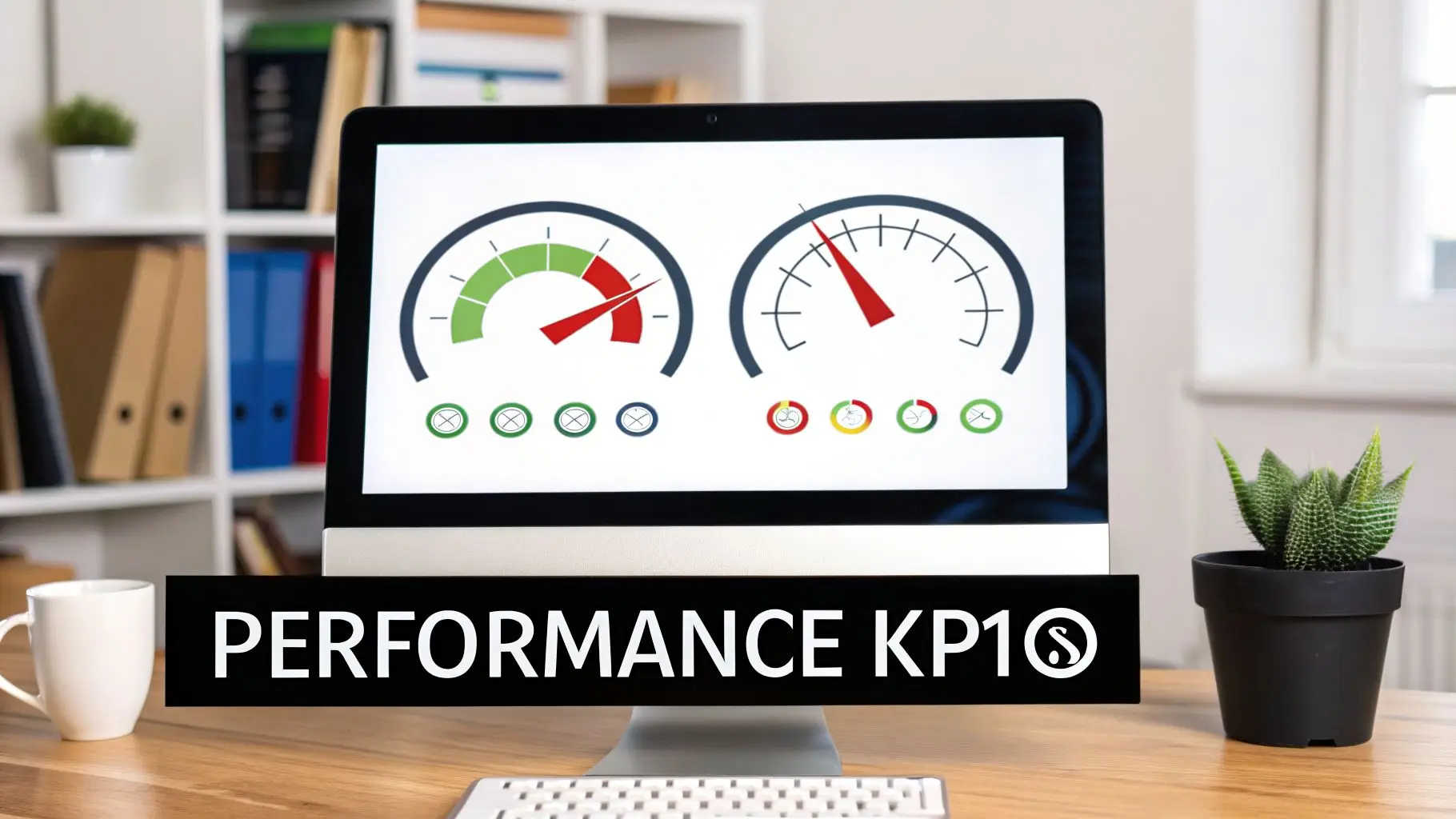
Tracking KPIs allows you to monitor critical operational aspects like on-time pickup rates, the timeliness of documentation delivery (such as Certificates of Destruction), and the accuracy of asset reporting. For example, a financial institution can measure data destruction accuracy rates to ensure 100% compliance, while a national enterprise can track pickup completion rates across different regions to identify and address logistical weak points. Without these metrics, underperformance can go unnoticed until a major compliance or security failure occurs.
Actionable Tips for Implementation:
- Establish Primary KPIs: Define 3-5 core KPIs that directly align with your business's most critical priorities. This could include metrics like a 95% on-time pickup rate or a 48-hour turnaround for receiving Certificates of Destruction.
- Use a "Traffic Light" System: Visualize performance data for quick assessment. Use a simple color-coded system: green for exceeding targets, yellow for meeting them, and red for falling below expectations. This helps prioritize areas needing immediate attention.
- Implement Automated Tracking: Where possible, use automated systems or shared dashboards to track performance data. This reduces manual effort, minimizes human error, and provides real-time visibility for both you and your vendor.
- Schedule Regular Reviews: Hold monthly or quarterly business reviews with vendor leadership specifically to discuss KPI performance. This creates a formal channel for accountability, problem-solving, and strategic alignment.
Key Takeaway: Performance data should be shared transparently with your vendor to foster a collaborative partnership focused on continuous improvement. This approach turns vendor management from a confrontational process into a joint effort to achieve shared goals, often leading to better service and a stronger long-term relationship.
4. Risk Management, Compliance Verification and Vendor Audit Program
Proactive vendor management best practices extend far beyond the initial contract, requiring an ongoing program of risk assessment, compliance verification, and systematic audits. This integrated approach ensures your ITAD and electronics recycling partners consistently maintain the security, environmental, and financial standards promised during selection. It's a continuous cycle of verification that protects your organization from evolving threats like data breaches, regulatory penalties, and supply chain disruptions.
A structured audit and compliance program moves your vendor relationship from a passive agreement to an active, monitored partnership. For example, a healthcare system must regularly verify its ITAD vendor’s adherence to HIPAA Business Associate Agreements, while a financial institution will want to see annual SOC 2 Type II reports to confirm data handling controls. This continuous oversight identifies and mitigates risks before they become critical incidents, safeguarding sensitive information and corporate reputation.
Actionable Tips for Implementation:
- Schedule a Cadence of Audits: Establish a clear audit schedule from the outset. This should include quarterly compliance checks (certifications, insurance), annual on-site facility audits, and process reviews.
- Verify Insurance and Certifications: Don't assume coverage is continuous. Annually request and verify certificates of insurance, ensuring they meet your minimums for cyber liability (e.g., $1-5M). Check that key certifications like R2 or e-Stewards are active and not expired.
- Request Third-Party Audit Reports: Ask your vendors for their latest SOC 2 Type II or equivalent third-party audit reports. These provide an unbiased assessment of their security controls and operational processes, saving you time and resources.
- Maintain a Risk Register: Create and maintain a risk register for each vendor. Document all identified issues, from minor process deviations to major security concerns, and track their resolution status and timeline.
Key Takeaway: A fundamental component of vendor risk management is conducting a comprehensive Risk Assessment to identify and evaluate potential vulnerabilities within your ITAD program. This initial assessment forms the baseline for your ongoing audit and verification activities, ensuring you focus on the areas of greatest potential impact. Trust must be earned and continuously verified through a documented, repeatable process.
5. Vendor Consolidation and Strategic Partnerships
A key element of advanced vendor management best practices involves moving from a fragmented, multi-vendor approach to one of strategic consolidation. This means intentionally reducing the number of ITAD and electronics recycling partners to build deeper, more meaningful relationships with a select few high-performers. By consolidating volume, you gain significant influence, simplify oversight, and can often secure more favorable contract terms and pricing.
Managing numerous vendors across different regions or business units creates administrative burdens and inconsistent service levels. A Fortune 500 company can achieve uniform security protocols and reporting by partnering with a single, nationwide ITAD provider. Similarly, a large healthcare system can ensure consistent HIPAA-compliant disposal of medical devices across all its facilities by standardizing with one expert vendor. This approach transforms the client-vendor dynamic from a simple transaction to a strategic alliance focused on mutual goals.
Actionable Tips for Implementation:
- Conduct a Coverage Analysis: Before consolidating, map your facility locations against the service areas of potential national or regional partners. Ensure your primary choice can cover all critical sites without relying on unvetted third-party subcontractors.
- Negotiate Volume-Based Tiers: Structure your contract with pricing that improves as your disposal volume increases. This creates a built-in incentive for the vendor to earn more of your business and for you to consolidate further.
- Establish a Dedicated Account Structure: For a true partnership, demand a dedicated account manager who understands your business, compliance needs, and internal processes. This single point of contact is vital for efficient communication and problem resolution.
- Develop a Contingency Plan: While consolidation offers benefits, it also concentrates risk. Work with your strategic partner to create a documented plan for handling service interruptions, ensuring business continuity.
Key Takeaway: A consolidated partnership should extend beyond logistics. True strategic partners offer custom reporting, system integrations, and joint planning committees to align their services with your long-term business objectives. This collaborative approach is a cornerstone of effective IT lifecycle management and maximizes the value derived from the relationship.
6. Supply Chain Transparency and Chain-of-Custody Documentation
Once your IT assets leave your facility, their security and compliance status can become a significant unknown. One of the most critical vendor management best practices is to demand and verify end-to-end supply chain transparency. This is achieved through rigorous chain-of-custody documentation, a set of verifiable records that track each asset from your door to its final disposition, whether it's remarketed, recycled, or destroyed.
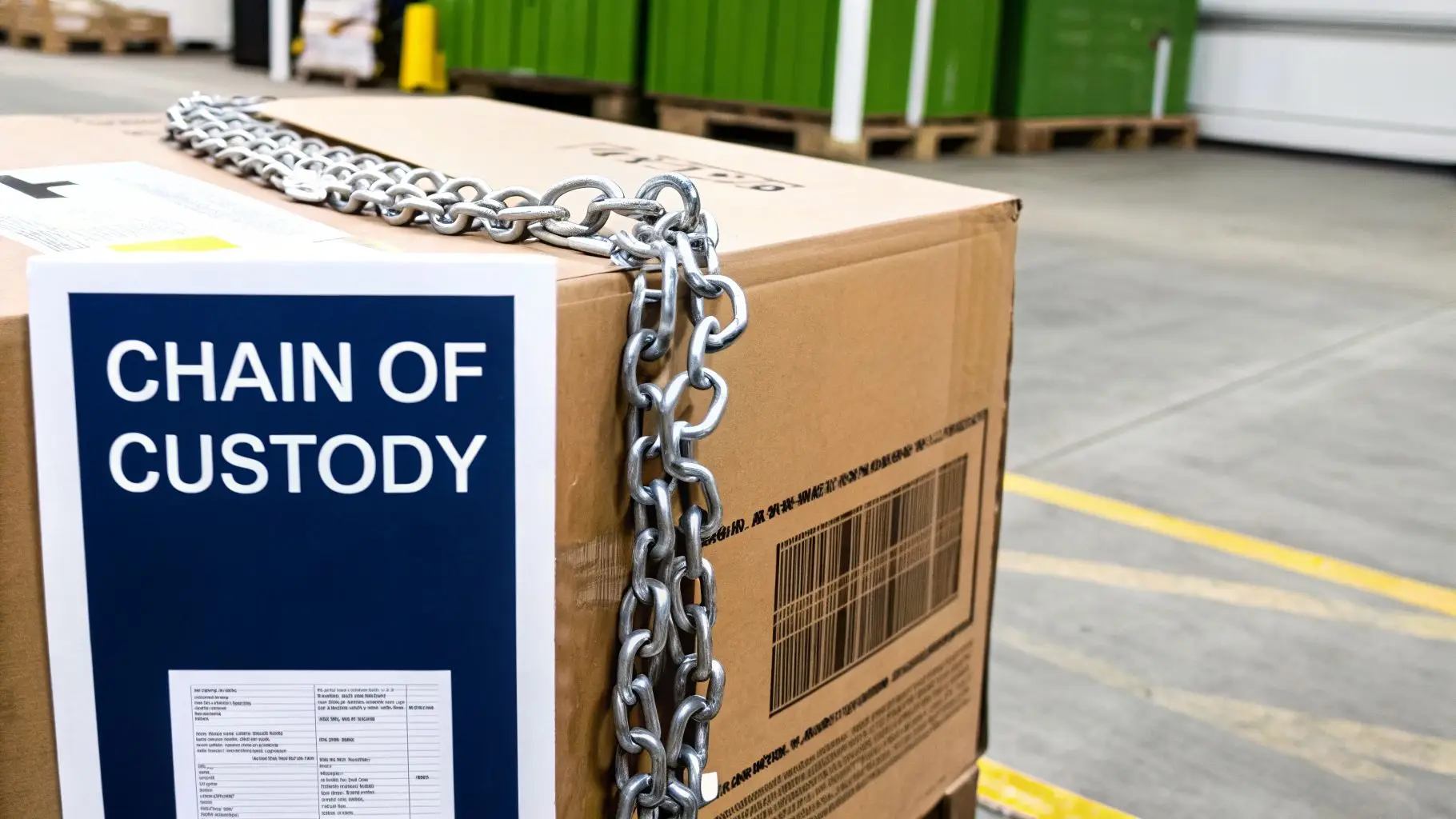
This process isn't just about paperwork; it's about transferring liability. In a world of strict data privacy laws and environmental regulations, a complete chain-of-custody log is your proof that you upheld your duty of care. For example, a healthcare system in Georgia can use this documentation to prove medical device data was destroyed in a HIPAA-compliant manner, while a government agency can confirm that classified equipment was securely processed according to federal standards.
Actionable Tips for Implementation:
- Mandate Digital Tracking and Portals: Require your vendor to use a barcode-based tracking system for every asset. Insist on access to a client portal where you can view pickup confirmations, processing status, and final certificates in real time.
- Establish Signature Requirements: Implement a policy where every transfer of assets, from your loading dock to the vendor’s truck and into their facility, is confirmed with a signed and dated chain-of-custody form.
- Demand Photographic or Video Evidence: For high-risk items like hard drives, request photographic or video evidence of the destruction process. This provides indisputable proof that data-bearing media was physically destroyed.
- Verify Transportation Security: Confirm that your vendor uses GPS-tracked, secure vehicles for all pickups. This minimizes the risk of asset loss or theft during transit, a common point of failure in the disposition process.
Key Takeaway: Your documentation is your defense. Store all chain-of-custody records, including asset lists and certificates, for a minimum of three to seven years, depending on your industry's specific regulatory requirements. The ability to produce a hard drive certificate of destruction on demand is essential for any compliance audit.
7. Vendor Communication and Relationship Management
A signed contract is the beginning, not the end, of the vendor relationship. Strong vendor management best practices depend on structured, consistent communication to keep the partnership productive and aligned with your goals. Establishing formal channels for dialogue, from tactical operational calls to strategic executive reviews, prevents minor issues from becoming major liabilities and ensures the vendor’s performance continues to meet your evolving data security and compliance needs.
This disciplined approach to relationship management transforms the vendor from a simple service provider into a strategic partner. For example, a data center decommissioning project requires constant coordination; monthly operational calls between the data center team and the vendor's account manager can resolve logistical hurdles in real-time. In contrast, an annual strategic planning session allows an enterprise IT director to forecast disposition volume, ensuring the vendor has the capacity and resources ready for the year ahead.
Actionable Tips for Implementation:
- Schedule Quarterly Business Reviews (QBRs): Hold formal QBRs with a documented agenda covering performance metrics, project status, and upcoming initiatives. Assign clear action items and owners to ensure accountability.
- Establish a Clear Escalation Path: Define and document the chain of command for resolving issues, from an operational manager to a director and, if needed, a senior executive. This prevents delays and confusion when problems arise.
- Implement Regular Operational Touchpoints: For teams with frequent interactions, such as data center staff, institute weekly or bi-weekly calls to address tactical issues, coordinate pickups, and provide immediate feedback.
- Use Feedback Mechanisms: Send Net Promoter Score (NPS) or simple satisfaction surveys quarterly or after major projects. Use the feedback to gauge satisfaction and identify specific areas for improvement, sharing constructive criticism using a model like SBI (Situation, Behavior, Impact).
Key Takeaway: Treat your ITAD vendor as an extension of your own team. Creating an executive steering committee for high-value partnerships (e.g., those with over $1M in annual spend) and recognizing vendor performance achievements fosters a collaborative environment. This proactive engagement is a cornerstone of effective vendor management best practices, ensuring long-term success and risk mitigation.
8. Cost Management and Value Recovery Optimization
A strategic approach to ITAD vendor management extends beyond simple compliance and security; it directly impacts your organization's bottom line. Effective cost management and value recovery optimization involves treating retired IT assets not as liabilities, but as potential revenue streams. This practice requires a shift from viewing ITAD as a mere disposal cost to a calculated process of maximizing financial return while controlling service expenses.
Implementing this approach means you actively negotiate pricing structures, consolidate logistics to reduce overhead, and partner with vendors who have robust resale channels. For instance, an Atlanta enterprise IT department might negotiate volume discounts for its 500+ annual device dispositions, while a data center operator could reduce transportation costs by 20-30% by consolidating pickups. The goal is to find the perfect balance where cost-efficiency never compromises essential security and compliance standards.
Actionable Tips for Implementation:
- Request Transparent, Granular Pricing: Demand a clear price list for different equipment categories (servers, laptops, drives) and services (data destruction, recycling, resale). This prevents hidden fees and allows for accurate cost-per-unit analysis.
- Consolidate Logistics for Discounts: Work with your vendor to schedule fewer, larger pickups instead of frequent small ones. Negotiate explicit discounts for monthly or quarterly consolidations, which reduces their logistical costs and passes savings to you.
- Prioritize IT Buyback Programs: For equipment less than five years old, focus on vendors with strong buyback and resale programs. This is often the most significant source of value recovery, turning decommissioned assets into direct budget offsets.
- Negotiate Volume and Term Commitments: Use your historical disposition data to negotiate volume-based discounts or price protection clauses in multi-year contracts. This provides cost predictability and rewards your loyalty.
Key Takeaway: Perform an annual Total Cost of Ownership (TCO) analysis comparing your current vendor’s model against alternatives. Factor in not just service fees but also the value recovered from asset sales. A detailed understanding of your IT equipment resale potential is fundamental to optimizing your vendor management best practices and overall IT budget.
9. Scalability Planning and Capacity Management
Exceptional vendor management best practices are forward-looking, anticipating future needs rather than just reacting to current demands. A critical component is scalability planning, a proactive strategy to ensure your ITAD vendor can handle your organization's growth, seasonal volume spikes, or large-scale, one-time projects. This involves moving beyond present-day service levels to secure commitments for future capacity, surge capabilities, and geographic reach.
Without this foresight, a successful partnership can quickly sour. An unexpected facility closure or a major data center decommissioning could overwhelm a vendor who is unprepared for the surge in volume, leading to logistical delays, storage issues, and potential security risks. For example, an enterprise planning a 50% growth in its workforce over three years must ensure its ITAD partner can manage a corresponding increase in end-of-life assets. Likewise, a national retailer needs a partner who can service new locations as the company expands.
Actionable Tips for Implementation:
- Define Volume Tiers: Establish clear volume definitions in your service level agreement. For instance, outline a baseline (e.g., 100 assets/month), an expected growth tier (e.g., 150 assets/month), and a surge tier (e.g., 500+ assets for a special project), each with agreed-upon response times and pricing.
- Request a Vendor Capacity Roadmap: During evaluation, ask potential partners to share their growth plans, including facility expansions, fleet additions, and staffing increases. This demonstrates their commitment to scaling alongside their clients.
- Negotiate Flexible Pricing: Build pricing structures into your contract that account for volume adjustments. This could include discounted rates for higher volumes or pre-negotiated pricing for emergency pickups, preventing unexpected cost overruns.
- Develop a Geographic Expansion Plan: If your organization is growing, work with your vendor to map their service coverage against your future locations. Secure commitments that they can either service these new areas directly or have vetted partners who can meet your standards.
Key Takeaway: For any significant, non-standard disposition like a data center migration or office cleanout, create a specific project charter with your vendor. This document should outline project-specific timelines, logistics, asset tracking requirements, and communication protocols, ensuring everyone is aligned and prepared for the increased operational tempo.
10. Contract Negotiation and Governance Framework
A signed contract is not the end of the vendor selection process; it's the formal beginning of the partnership. An effective contract negotiation and governance framework is one of the most critical vendor management best practices, transforming verbal agreements into a legally binding blueprint for the entire relationship. This framework ensures that all operational, security, financial, and compliance requirements are explicitly defined and mutually agreed upon, protecting your organization from ambiguity and future disputes.
This structured approach moves beyond a standard template to create a customized agreement that reflects the specific risks and requirements of IT asset disposition. For example, a multi-year Master Services Agreement (MSA) for a national enterprise will require clauses for tiered service levels and logistics across multiple states, whereas a one-time data center decommissioning project will need a detailed Statement of Work (SOW) specifying exact equipment handling protocols and strict project timelines.
Actionable Tips for Implementation:
- Define Scope Explicitly: Clearly document what services are included and, just as importantly, what is not included. This prevents scope creep and unexpected charges for services assumed to be part of the standard fee.
- Specify Security and Compliance Mandates: The contract must require specific data destruction methods (e.g., NIST 800-88 standards), proof of destruction, and a Certificate of Recycling. Also, define minimum insurance levels, such as a $1-5 million cyber liability policy.
- Establish Clear Governance Terms: Incorporate a defined process for contract amendments, automatic renewal clauses that include an annual review opportunity, and pricing escalation limits (e.g., capping annual increases at 3%).
- Plan for the End: A strong contract includes a clear exit strategy. Specify a 60-90 day termination notice period with a requirement for the outgoing vendor to support a smooth transition to a new partner, ensuring business continuity.
Key Takeaway: Your contract is your primary enforcement tool. It must contain a formal dispute resolution process, typically starting with negotiation, moving to mediation, and finally to arbitration if necessary. Including these steps provides a clear, structured path to resolve conflicts without immediately resorting to costly litigation.
10-Point Vendor Management Best Practices Comparison
| Practice / Program | Implementation Complexity 🔄 | Resource Requirements ⚡ | Expected Outcomes 📊 | Ideal Use Cases 💡 | Key Advantages ⭐ |
|---|---|---|---|---|---|
| Vendor Selection and Qualification Framework | Medium–High — multi-step evaluations and audits | Moderate–High — compliance experts, site audits, documentation | Reduced vendor risk; verified compliance and security | Regulated sectors selecting long-term ITAD partners (healthcare, finance, govt) | Ensures compliant partners and clear expectations ⭐⭐⭐ |
| Service Level Agreement (SLA) Development and Management | High — legal, procurement and detailed KPI definition | High — legal counsel, procurement, ongoing monitoring | Clear accountability, enforceable timelines and remedies | Time-sensitive operations (data centers, HIPAA environments) | Measurable commitments and legal protection ⭐⭐⭐ |
| Vendor Performance Metrics and KPI Tracking | Medium — define KPIs and dashboarding | Moderate — tracking systems, analysts, reporting tools | Objective performance insight; early issue detection | Multi-vendor programs and continuous improvement initiatives | Data-driven vendor decisions and benchmarking ⭐⭐ |
| Risk Management, Compliance Verification & Audit Program | Very High — continuous audits and specialized reviews | Very High — auditors, compliance tools, third-party reports | Reduced regulatory exposure; documented audit evidence | High-risk or highly regulated environments requiring ongoing assurance | Prevents fines and validates certifications ⭐⭐⭐⭐ |
| Vendor Consolidation & Strategic Partnerships | Medium — strategic planning and negotiation | Moderate — account management, integration work | Lower management overhead; better pricing and consistency | Large organizations seeking leverage and simplified operations | Cost savings, stronger vendor accountability ⭐⭐ |
| Supply Chain Transparency & Chain-of-Custody Documentation | Medium–High — tech + process changes to track assets | High — RFID/barcode, portals, photo/GPS evidence, integration | Verifiable audit trail; liability transfer and compliance records | Situations requiring forensic evidence or strict auditability | Tangible proof of handling and reduced disputes ⭐⭐⭐ |
| Vendor Communication & Relationship Management | Low–Medium — governance and scheduled interactions | Moderate — account managers, meeting cadence, feedback tools | Improved collaboration; faster issue resolution | Strategic accounts and multi-stakeholder programs | Proactive issue handling and partnership growth ⭐⭐ |
| Cost Management & Value Recovery Optimization | Medium — pricing models and resale programs | Moderate — finance analysts, market data, bid processes | Lower net program cost; recovered resale value | High refresh volumes or budget-conscious programs | Cost control plus revenue from buybacks ⭐⭐ |
| Scalability Planning & Capacity Management | Medium–High — forecasting and surge agreements | Moderate–High — capacity commitments, backup vendors | Predictable handling of growth and one-off surges | Migrations, large decommissions, planned growth | Reliability during peak events and projects ⭐⭐ |
| Contract Negotiation & Governance Framework | High — legal drafting and governance structure | High — legal, procurement, governance oversight | Clear legal terms, renewal controls, dispute mechanisms | Multi-year or high-value engagements and regulated contracts | Strong legal protection and clarified responsibilities ⭐⭐⭐ |
Building a Bulletproof ITAD Program with Superior Vendor Management
Navigating the complexities of IT Asset Disposition (ITAD) requires more than just finding a company to haul away old electronics. It demands a structured, security-focused, and compliant approach to vendor management. As we’ve explored, the difference between a successful ITAD program and a costly data breach often lies in the quality of your vendor partnerships and the rigor of your oversight. Moving from a reactive, transactional relationship to a proactive, strategic partnership is the key to protecting your organization’s most sensitive assets.
The journey to superior vendor management is built on a foundation of deliberate, actionable steps. It begins with a meticulous Vendor Selection and Qualification Framework, ensuring you partner only with certified and capable providers from the outset. This initial diligence sets the stage for success, preventing future compliance headaches and security lapses. Once selected, that relationship must be governed by a detailed Service Level Agreement (SLA) that leaves no room for ambiguity regarding data destruction, reporting timelines, and environmental compliance.
From Theory to Action: Implementing Robust Vendor Oversight
A well-written contract is only the beginning. True control comes from active management and verification. This is where many vendor management programs fall short. Implementing the best practices we have detailed transforms your ITAD process from a cost center into a strategic function that actively mitigates risk and recovers value.
Key pillars of this transformation include:
- Data-Driven Performance Tracking: Moving beyond gut feelings requires establishing and monitoring clear Vendor Performance Metrics and KPIs. This ensures your partner consistently meets security, logistical, and financial targets.
- Proactive Risk Mitigation: A robust Risk Management and Vendor Audit Program is non-negotiable. Regular, in-person audits and verification of your vendor’s certifications (like R2, e-Stewards, and NAID AAA) are your best defense against downstream liability and data security failures.
- Transparent Chain of Custody: Demanding end-to-end Supply Chain Transparency and Chain-of-Custody Documentation for every single asset is fundamental. This documentation is your proof of compliance and secure handling, from your facility to final disposition.
- Strategic Relationship Building: Effective Vendor Communication and Relationship Management fosters a partnership where your vendor acts as an extension of your team, providing insights and proactively addressing potential issues.
By embracing these vendor management best practices, you build a resilient ITAD program that does more than just dispose of old equipment. It safeguards your brand’s reputation, protects your customers’ data, ensures regulatory compliance, and optimizes the financial return on retired assets. The principles of rigorous procurement, clear SLAs, constant auditing, and strategic partnership are the cornerstones of this security. The result is a bulletproof system that gives you complete confidence in the secure and responsible management of your technology lifecycle. This structured approach, supported by a partner who understands these requirements, is the definitive way to manage ITAD risk effectively.
Contact Beyond Surplus for certified electronics recycling and secure IT asset disposal in Atlanta, Georgia. We build our services around these exact vendor management best practices, providing the transparency, documentation, and security that enterprise clients demand. Fortify your IT asset disposition strategy by partnering with a provider that meets and exceeds these critical standards for secure e-waste management and IT asset recovery.