
Universal waste management is the streamlined, EPA-regulated process for recycling common yet hazardous items found throughout commercial facilities. These regulations simplify how businesses in the United States dispose of items like batteries, fluorescent lamps, and certain electronic devices, offering a more manageable compliance pathway than the stringent rules for other hazardous waste streams. For IT, facilities, and operations managers, understanding these rules is critical for avoiding fines and ensuring environmental responsibility.
What Is Universal Waste in a Business Context?
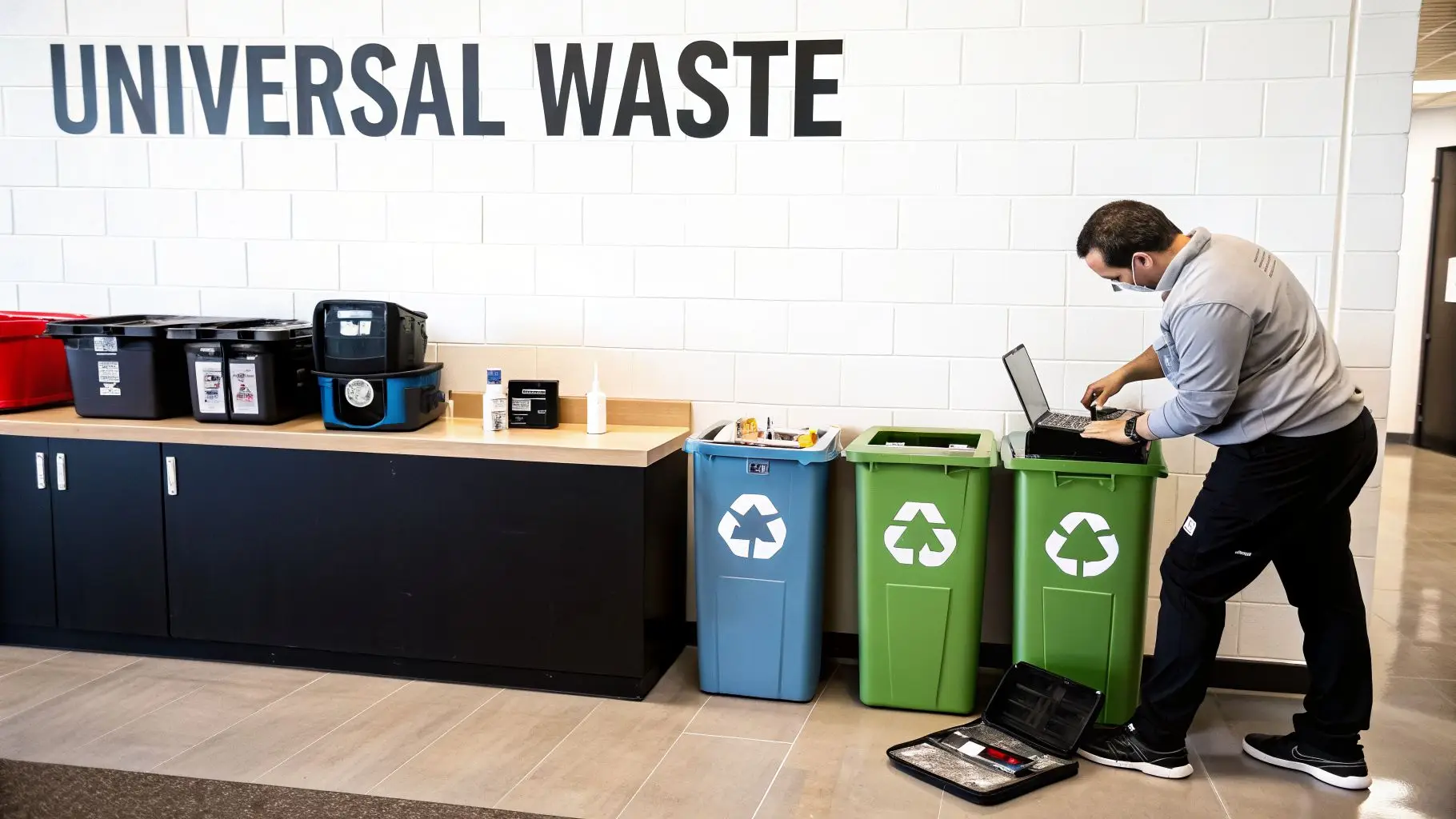
Universal waste occupies a middle ground—it’s not as innocuous as general office trash but is less dangerous than highly regulated hazardous materials. These are items commonly used in commercial and enterprise settings. While they contain hazardous components like mercury in fluorescent bulbs or heavy metals in batteries, they pose a lower risk when handled correctly. The EPA's universal waste program was specifically designed to encourage proper recycling by reducing the regulatory burden on businesses.
This distinction is crucial for any professional managing a company's assets or facilities. Improperly disposing of these items can lead to significant regulatory penalties and environmental liability. A robust universal waste management plan is not just best practice; it is a fundamental component of corporate compliance and risk management.
Why It Matters for Your Business
For IT, facilities, and procurement departments, managing universal waste is a routine part of the asset lifecycle. Much of the equipment that supports daily operations, from data centers to office lighting, will become universal waste at its end-of-life. Proper disposal is essential for maintaining a safe and compliant workplace.
A formal program ensures your business:
- Avoids Regulatory Penalties: Federal, state, and local agencies enforce strict rules for hazardous material disposal. A compliant universal waste program is your first line of defense against costly violations.
- Protects Employee Safety: Adhering to correct handling and storage protocols minimizes the risk of workplace accidents, such as a broken fluorescent lamp releasing mercury vapor.
- Enhances Corporate Responsibility: Demonstrating a tangible commitment to environmentally sound practices boosts your company's reputation and helps achieve sustainability targets.
The challenge of waste management is escalating. Global waste projections indicate a significant increase in municipal solid waste, reaching 3.8 billion tonnes by 2050. For any organization managing technology assets, this underscores the critical need for expert partners in secure, responsible IT asset disposal.
Partnering with a certified vendor simplifies the entire process. Instead of your team deciphering complex regulations, a specialist ensures every item is handled, transported, and recycled according to the law.
This is where a professional IT asset disposition (ITAD) provider becomes invaluable. They not only manage the universal waste but also provide the complete documentation required to prove compliance. To better understand the standards these partners must meet, you can learn more about electronics recycling certifications and their significance for your business. An expert partner removes the guesswork, transfers liability, and delivers complete peace of mind.
Understanding EPA Handler Obligations
The EPA's universal waste regulations, detailed in 40 CFR Part 273, are designed to facilitate safer, more widespread recycling by creating a less restrictive framework for certain hazardous materials. Understanding your business's obligations is the first step toward building a compliant and efficient waste management program.
Your specific responsibilities are determined by the amount of universal waste accumulated on-site at any one time. The EPA categorizes handlers into two groups based on this volume. Correctly identifying your status is key—it prevents over-compliance, which wastes resources, and under-compliance, which can lead to significant fines.
Small vs. Large Quantity Handlers
Your facility's status is determined by a single threshold. It’s a straightforward distinction with major implications for your recordkeeping and reporting requirements.
Small Quantity Handler of Universal Waste (SQHU): This is the most common classification for businesses. If your facility never accumulates 5,000 kilograms (approximately 11,000 pounds) or more of total universal waste at any given time, you are an SQHU.
Large Quantity Handler of Universal Waste (LQHU): The moment your accumulated universal waste reaches or exceeds 5,000 kilograms, your facility is classified as an LQHU. This status brings with it more stringent requirements.
An easy analogy: operating as an SQHU is like driving a personal vehicle, requiring adherence to basic rules. Becoming an LQHU is like operating a commercial truck—suddenly, you are responsible for logbooks, notifications, and more extensive paperwork. Determining your category is fundamental to proper universal waste management.
To clarify, here is a breakdown of the differences between the two handler statuses.
Universal Waste Handler Status At-a-Glance
| Requirement | Small Quantity Handler (SQHU) | Large Quantity Handler (LQHU) |
|---|---|---|
| Accumulation Limit | Never accumulates 5,000 kg or more | Accumulates 5,000 kg or more |
| Notification | Not required to notify the EPA | Must notify the EPA and obtain an EPA ID number |
| Recordkeeping | Not required to keep records of shipments | Must keep records of each shipment received and sent |
| Employee Training | Must inform employees of proper handling & emergencies | Must ensure employees are thoroughly trained on procedures |
| Storage Time Limit | One year | One year |
| Labeling | Required | Required |
| Response to Releases | Required | Required |
As shown, the core responsibilities for safe handling are consistent, but the administrative burden increases significantly once the 5,000 kg threshold is crossed.
Core Compliance Pillars for All Handlers
Regardless of handler status, several universal rules apply. These foundational practices are easy to implement and essential for maintaining a safe and compliant program.
Accumulation Time Limits: You cannot store universal waste on-site for more than one year. The clock starts the moment an item is designated as waste. This rule ensures materials move efficiently toward a proper recycling or disposal facility rather than being stockpiled indefinitely.
Proper Labeling and Containers: Every item or container of universal waste must be clearly marked. A simple label such as "Universal Waste—Batteries" or "Waste Lamps" is sufficient. This prevents materials from being mixed with regular trash and ensures handlers are aware of the contents.
Employee Training: Personnel who manage or handle universal waste require basic training. They must know how to handle materials safely and what to do in an emergency, such as responding to a spill from a broken fluorescent bulb or a leaking battery.
Response to Releases: Your team must be prepared to immediately contain any spills or leaks. For instance, if a container of batteries begins to leak, a clear procedure is needed to clean up the release, contain the damage, and repackage the items safely.
The one-year accumulation limit is a strict deadline. You must be able to prove how long waste has been on-site, either by dating the container when accumulation begins or through a detailed inventory system.
For companies operating in specific states, it’s vital to understand both these federal rules and any state-specific additions. Our guide on compliant electronics recycling in Georgia offers detailed insights for navigating local laws. Working with a certified expert like Beyond Surplus removes the guesswork, providing documented proof that all obligations are met while shifting the regulatory burden from your team to ours.
Identifying Universal Waste in Your Facility
Now that you understand your responsibilities, let's identify where this universal waste is located within your facility. These items are often so common they blend into the background, but recognizing them is the first step toward a sound universal waste management plan.
For most businesses, universal waste is concentrated in a few predictable areas, particularly for those managing IT infrastructure or the building itself. The EPA establishes the baseline categories, but remember—states can and often do add their own items to the list.
Batteries: The Powerhouse of Universal Waste
Batteries are ubiquitous in a commercial environment. They are in laptops, emergency lighting systems, and the uninterruptible power supplies (UPS) that protect your data centers. Once they can no longer hold a charge, they must be managed with care.
In a typical enterprise setting, you will encounter:
- Lithium-Ion (Li-ion) Batteries: Found in all portable enterprise technology—laptops, company-issued smartphones, tablets, and handheld scanners.
- Sealed Lead-Acid (SLA) Batteries: The heavy-duty power sources for your UPS units, security alarm panels, and emergency lighting.
- Nickel-Cadmium (Ni-Cd) and Other Rechargeables: Common in older equipment like two-way radios, cordless power tools, and some telecommunications systems.
Managing these spent batteries is non-negotiable. Beyond Surplus provides services specifically for this waste stream; explore our solutions for business battery recycling and disposal to ensure compliance.
Lamps and Bulbs: Illuminating Potential Hazards
The fluorescent bulbs lighting your office, warehouse, or data center are another major source of universal waste. While energy-efficient, they contain a small amount of mercury, making proper disposal essential.
When a fluorescent bulb breaks, it can release mercury vapor, creating an immediate health risk for employees. A compliant program must include a clear plan for safely cleaning up broken lamps.
This category includes more than just standard tubes:
- Fluorescent Tubes: The long, linear bulbs used in most overhead commercial lighting.
- Compact Fluorescent Lamps (CFLs): The spiral-shaped bulbs often found in smaller fixtures.
- High-Intensity Discharge (HID) Lamps: The powerful lights used for parking lots, stadiums, and high-ceiling warehouses.
Mercury-Containing Equipment: The Silent Hazard
Beyond lamps, mercury is present in a surprising amount of older commercial and industrial equipment. While less common in new construction, many facilities still have these devices in operation.
Facilities managers and IT professionals should look for:
- Older Thermostats: Many analog, dial-style thermostats contain mercury switches.
- Switches and Relays: These may be found inside industrial control panels and heavy machinery.
- Manometers and Barometers: These are more common in laboratory, medical, or manufacturing environments.
The Role of State-Specific Rules and E-Waste
Federal rules are only a starting point. States have the authority to classify additional materials as universal waste to facilitate easier recycling. A growing number of states now include electronic waste (e-waste)—such as computers, monitors, and printers—in their universal waste programs. This is because much of this equipment contains the same hazardous materials, like lead and mercury, found in other universal waste.
This is why a one-size-fits-all approach to universal waste management is ineffective. A 2025 Global Waste Index report noted that the U.S. is a top generator of municipal solid waste, with a significant portion ending up in landfills. For any company with a large IT footprint, this data highlights the importance of partnering with a professional to keep hazardous e-waste out of landfills and ensure full compliance.
How to Build a Compliant Universal Waste Program
Now that you know what universal waste is, how do you manage it without creating a compliance bottleneck? Building a robust program is not about inventing complex new procedures but implementing simple, clear, and repeatable systems that your entire team can follow.
The goal is control and clarity. This requires designated collection areas, straightforward communication, and a well-defined process for these materials from collection to final, responsible disposal.
Step 1: Designate and Mark Your Accumulation Areas
First, establish specific, centralized locations where all universal waste will be collected. These are your universal waste accumulation areas. They should be easily accessible to authorized staff but secure enough to prevent unauthorized access and commingling with regular trash.
Think of it as a secure drop-off point for sensitive materials. You would not leave valuable packages unattended in a busy hallway, and you should not allow spent batteries or old fluorescent bulbs to pile up in unsecured areas. A locked storage closet or a caged-off section in a warehouse is an ideal solution.
Once you have selected your locations, label them clearly with bold signage that states:
- "Universal Waste Accumulation Area"
- "Authorized Personnel Only"
This simple action is your first line of defense, preventing improper disposal and directing staff to the correct location.
Step 2: Set Up a Clear Labeling System
Every single container—or individual item if not boxed—must be clearly labeled. This is a non-negotiable EPA requirement. The label must identify the type of waste and, critically, the date you started collecting it.
Use durable, easy-to-read labels. For example:
- "Universal Waste – Batteries"
- "Waste Lamps"
- "Universal Waste – Mercury-Containing Equipment"
Next to the description, you must record the accumulation start date. This is the day the first piece of waste was placed in the container. That date begins the one-year countdown for disposal, so accurate tracking is essential for compliance. A simple logbook or spreadsheet is an excellent tool for managing these dates.
Step 3: Train Your Team on Proper Procedures
Your program's effectiveness depends on your team. Any employee who may handle or encounter universal waste needs basic training. This training does not need to be extensive, but it must cover the essentials.
Effective training empowers your team to be your first line of defense. It translates regulatory requirements into practical, everyday actions that protect both your employees and your business from liability.
At a minimum, training should ensure every relevant employee can:
- Identify the different types of universal waste in your facility.
- Separate it from the general waste stream.
- Understand the proper handling procedures for each waste type.
- Know the emergency response procedures for a spill or release, like a broken lamp or leaking battery.
This is a core pillar of your universal waste management strategy, creating a consistent and safe response across your organization. The following flowchart illustrates the straightforward identification process for common waste streams.

As the chart shows, once an item is identified as a battery, lamp, or mercury device, it is directed into the universal waste program for specialized handling, keeping it out of the general waste stream.
Step 4: Partner with a Certified Disposal Vendor
This is the final and arguably most critical step. You must select a qualified partner to transport and recycle your universal waste. Remember, your business is legally responsible for waste from "cradle to grave"—until it has been properly and finally processed. Your choice of vendor is what closes this liability loop.
Following industry best practices, such as understanding SF6 recycling best practices for specialized equipment, demonstrates a vendor's commitment to high standards. This is the level of expertise you should demand.
When vetting a potential vendor, conduct thorough due diligence. Ensure they are certified to handle your specific waste streams. Request proof of a complete chain-of-custody process, culminating in a final Certificate of Recycling. A qualified partner completes your program, providing assurance that your waste is managed responsibly from your facility to its final destination.
Protecting Your Business With a Clear Chain of Custody
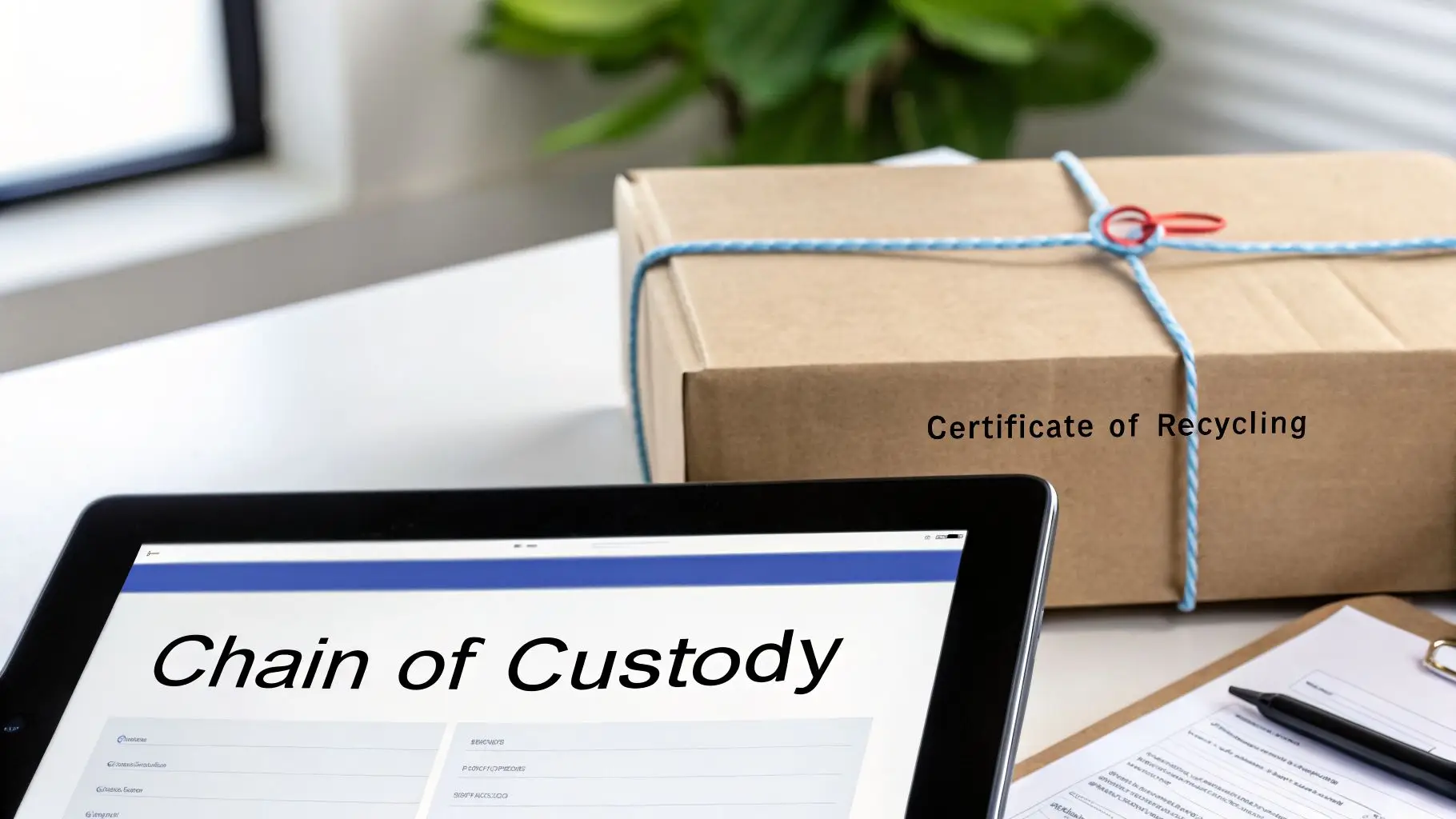
Properly handling universal waste is only half the battle. The other half—which truly protects your business—is proving you did everything correctly. In universal waste management, documentation is not just paperwork; it is your legal shield.
An unbroken chain of custody creates a clear, auditable trail proving you met every regulatory requirement, from the moment waste leaves your facility to its final, responsible destruction. Think of it as a relay race where the baton is your liability. When you hand it off to a certified vendor with proper documentation, you officially transfer that responsibility.
Regulators will not simply take your word for it during an audit. They will demand proof, and a complete chain-of-custody file provides the undeniable evidence that you complied with the law, protecting your company from steep fines and legal challenges.
The Role of Shipment and Disposal Records
While your internal logs are the starting point, the documents you receive from your disposal partner are what truly close the loop. Every shipment of universal waste leaving your facility must be tracked with detailed records that form a seamless paper trail.
These are the key documents that serve as your proof of compliance:
- Shipment Manifests or Bills of Lading: These records detail what was collected, the quantity, and its destination. This is the official handoff document between your business and the transporter.
- Certificates of Recycling: This is arguably the most critical document. Issued by the final processing facility, it confirms that your universal waste was received and properly recycled or disposed of in accordance with all federal and state laws.
- Certificates of Data Destruction: For IT assets that are also universal waste (like laptops with batteries), this document proves all sensitive data was securely destroyed before the device was recycled.
This documentation is non-negotiable. To see what a compliant final record looks like, you can review this Destruction Certificate template.
How a Professional ITAD Partner Manages Your Paper Trail
A professional IT Asset Disposition (ITAD) partner like Beyond Surplus is structured to manage this entire paper trail for you. We understand your team is focused on core business operations, not on becoming environmental regulation experts. Our service is designed to deliver auditable proof that satisfies regulators and supports your corporate sustainability goals, with no administrative burden on your team.
The success of any waste management system relies on its infrastructure and commitment. Partnering with a specialist means adopting a proven system that guarantees compliance and transfers risk, allowing you to focus on your business.
This principle is demonstrated globally. For example, Estonia's dramatic rise from 32nd to 3rd in the Global Waste Index was not accidental; it resulted from building comprehensive infrastructure and clear organizational processes. For businesses, this highlights the value of engaging a specialized partner who applies the same systematic rigor to managing your technology assets and the waste they produce.
Choosing the Right Partner for Your Universal Waste
Proper universal waste management is more than a compliance task; it is a critical component of responsible business operations. Getting it right protects you from significant fines, keeps your employees safe from hazardous materials, and strengthens your company’s sustainability credentials. However, the regulations, handler duties, and paperwork can quickly become a major distraction from core business activities.
This is where engaging a specialist provides a clear return on investment. Instead of burdening your team with compliance headaches, you can delegate the entire process to an expert. You gain the confidence that every detail is handled correctly, freeing your staff to focus on their primary roles.
Why Outsourcing to a Specialist Makes Sense
Choosing a certified partner for your universal waste is not just about disposal. It is a strategic decision for managing risk and improving operational efficiency.
The right partner provides:
- Guaranteed Compliance: A dedicated partner lives and breathes these regulations. They stay current with every federal and state rule change so you don't have to, ensuring your program is always compliant.
- Time and Cost Savings: Consider the employee hours spent on training, tracking waste streams, and managing paperwork. Outsourcing frees up those internal resources.
- Enhanced Reputation: Working with a certified recycler is a clear statement of your commitment to environmental stewardship. It is a tangible way to demonstrate corporate responsibility to customers, stakeholders, and the community.
Ultimately, a professional partner provides a complete, auditable trail that closes the loop on liability the moment waste leaves your facility.
Beyond Surplus: Your All-in-One IT Disposal Partner
For most businesses, universal waste is directly tied to IT equipment. The batteries in laptops, the mercury in older flat-panel display backlights, and the components of a UPS battery backup all fall under these regulations. This is precisely where Beyond Surplus offers a seamless, integrated solution.
We are more than just a disposal vendor; we are a complete IT asset disposition (ITAD) partner. We are fully equipped to manage the universal waste generated by your technology, and we also handle your entire equipment retirement lifecycle from start to finish.
By integrating your universal waste and ITAD programs under one roof, you create a single, secure chain of custody for all retired assets. This simplifies vendor management, reduces costs, and eliminates potential compliance gaps.
From secure data destruction and recovering value from used assets to certified recycling, we cover every aspect of IT and electronics disposal. Let us manage the compliance complexities so you can focus on your business.
Ready to achieve total compliance and peace of mind? Contact Beyond Surplus for certified electronics recycling and secure IT asset disposal.
Frequently Asked Questions About Universal Waste Management
Even with a solid plan, questions often arise regarding universal waste. We frequently hear these from business owners, IT managers, and facilities professionals across the United States. Here are clear answers to the most common inquiries.
How Is Universal Waste Different from Hazardous Waste?
Think of it as the difference between an express lane and the regular toll lanes on a highway. Both are part of the same road system, but one route is much faster and simpler.
Universal waste is a category of hazardous waste. However, the EPA created this special subcategory for common items like batteries and lamps to streamline and encourage recycling. It reduces the administrative burden, making it more likely that businesses will dispose of these materials correctly.
Managing regular hazardous waste involves extensive paperwork, strict cradle-to-grave tracking, and specialized training. In contrast, universal waste management offers a simplified path focused on proper storage, clear labeling, and timely removal from your site.
How Long Can Our Business Store Universal Waste On-Site?
The rule is firm and straightforward: you can store universal waste at your facility for no longer than one year. This one-year clock begins the moment the first piece of waste is placed into a collection container.
This is precisely why dating your containers is not just a best practice—it is a core compliance requirement. Simply writing the "accumulation start date" on each container or maintaining a clear log is the best way to prove you are following the rules during a regulatory inspection.
Do We Need a Special Permit to Transport This Waste?
Generally, no. As a business that generates universal waste (classified as a "handler"), you do not need a special permit to transport your own waste to another approved handler or a certified recycling facility.
The rules differ for companies whose primary business is transporting universal waste—they are considered "universal waste transporters" and have specific requirements. This distinction allows you to hire a certified vendor like Beyond Surplus to manage all transportation and logistics, simplifying the process for your business.
What Happens If Universal Waste Is Mixed with Regular Trash?
Accidentally disposing of universal waste in the regular trash is a mistake with serious and costly consequences. If an auditor discovers items like batteries or lamps in your general waste stream, they can reclassify the entire dumpster's contents as hazardous waste.
This simple error can lead to major fines, expensive cleanup costs, and significant legal liabilities. Keeping universal waste separate is not a suggestion; it is the foundation of a safe, compliant, and risk-averse program.
The risk is not worth it. Improper disposal can contaminate the environment, and the financial penalties for non-compliance can be substantial. This is a costly mistake that is easily avoided with clear separation, proper labeling, and basic employee training.
Ready to simplify your universal waste compliance and secure your IT asset disposal process? Contact Beyond Surplus for a comprehensive consultation and see how our certified services can protect your business. Get your free quote at https://atechdist.com today.