For Georgia businesses, disposing of retired IT equipment is often seen as a compliance gray area. The absence of a specific statewide e-waste law can lead IT managers to underestimate the risks, but this is a critical oversight. Federal laws create non-negotiable compliance rules for all commercial entities. For businesses in Georgia, professional, sustainable IT disposal is not just an eco-friendly choice; it's a fundamental component of risk management.
This guide is for business owners, IT managers, and procurement professionals in Georgia seeking to navigate the complexities of secure and compliant IT asset disposition (ITAD).
Understanding Georgia's IT Disposal Landscape
While Georgia lacks a state-specific electronics recycling mandate for businesses, federal regulations concerning data privacy and hazardous waste are fully in effect. This places the responsibility squarely on organizations to manage their end-of-life electronics properly. If your company handles any sensitive information—from customer data and employee records to proprietary trade secrets—these federal rules apply to you without exception.
Two key federal mandates define the commercial disposal landscape:
- The FTC Disposal Rule: This rule requires businesses to take "appropriate measures" to dispose of sensitive consumer information. Simply discarding an old office computer in a dumpster without certified data destruction is a direct violation that can result in significant fines.
- The EPA’s Resource Conservation and Recovery Act (RCRA): This act governs the disposal of solid and hazardous waste. Many electronics, particularly older CRT monitors and batteries, contain hazardous materials like lead and mercury. Improper disposal can lead to severe environmental penalties and long-term liability for your company.
The Real Risks and Rewards of IT Disposal in Georgia
The method your business chooses for disposing of old technology directly impacts its financial health, legal standing, and public reputation.
Opting for improper disposal channels exposes your business to data breaches and federal penalties. Conversely, partnering with a certified IT Asset Disposition (ITAD) expert is a strategic move that mitigates risk, strengthens your brand's commitment to security, and can generate revenue through value recovery.
This table highlights the stark contrast between unprofessional disposal and a certified, professional approach.
| Disposal Method | Potential Risks of Improper Disposal | Key Benefits of Certified Disposal |
|---|---|---|
| DIY/Uncertified | Severe Financial Penalties: Fines from the EPA and FTC can reach thousands of dollars per violation, transforming a seemingly simple disposal task into a major financial liability. | Guaranteed Compliance: A certified partner provides Certificates of Data Destruction and Recycling, creating an auditable paper trail that proves due diligence and transfers liability. |
| Landfill/Trash | Data Breach & Reputational Damage: A single discarded hard drive with unsecured data can lead to a catastrophic breach, eroding customer trust and causing irreparable harm to your brand's credibility. | Bulletproof Data Security: Professional data destruction methods like on-site shredding physically demolish data-bearing devices, making information recovery impossible and securing your corporate secrets. |
| Scrap Dealer | Environmental Liability: If your e-waste is illegally dumped or exported, your company can be held legally and financially responsible for cleanup costs, even years after the fact. | Environmental Stewardship: Certified vendors adhere to strict R2 or e-Stewards standards, ensuring hazardous materials are managed safely and valuable commodities are recovered for the circular economy. |
The economic upside of responsible recycling is also significant. While Georgia may not have a dedicated e-waste law, the state's recycled materials industry is a powerful economic engine.
In fact, Georgia's recycled materials sector is projected to have an economic impact of $5.2 billion in 2026. By engaging in certified electronics recycling, your business contributes to this valuable circular economy.
Ultimately, professional IT disposal is an exercise in proactive risk management. It converts a potential liability into a strategic advantage, delivering peace of mind while demonstrating corporate responsibility and a commitment to data security. Learn more about how Beyond Surplus provides sustainable electronics recycling in Georgia in our detailed guide.
Building Your Sustainable ITAD Implementation Plan
Transforming a storeroom of obsolete hardware into a secure, compliant, and valuable asset stream begins with a strategic plan. For any IT manager or business owner in Georgia, this process is about creating a clear, actionable roadmap for responsible IT asset disposition.
The foundational step is to create a detailed inventory of all IT assets. You cannot secure or manage what you do not track. This inventory should be a dynamic record, tracking every server, laptop, monitor, and peripheral from procurement to end-of-life.
Without this comprehensive asset list, ensuring every device is accounted for and every piece of data is properly sanitized is impossible.
Establishing a Robust Data Destruction Policy
With a complete inventory, the next critical step is to establish a formal data destruction policy. This internal document is non-negotiable for any Georgia business serious about preventing a data breach. It must clearly define the protocols for handling different types of data and devices.
Your policy should specify the "when" and "how" for three core methods of data destruction:
- Software Wiping: Utilizes specialized software to overwrite data on a hard drive, rendering it unrecoverable by software-based tools. This is ideal for devices intended for reuse or resale, as it preserves the hardware's functionality.
- Degaussing: Employs a powerful magnetic field to instantly and permanently erase all data from magnetic media like hard disk drives (HDDs) and backup tapes. This process renders the drive unusable.
- Physical Shredding: This is the most absolute form of data destruction. The hard drive or solid-state drive is physically shredded into small fragments, making data recovery impossible. It is the required method for highly sensitive data or devices at their final end-of-life.
A common and costly mistake is assuming a factory reset or file deletion provides adequate data security. This data is often easily recoverable. A formal policy requiring NIST 800-88 compliant wiping, degaussing, or shredding is the only way to guarantee data is irretrievably destroyed.
This flowchart illustrates how to convert potential risk into a strategic reward through partnership with a certified ITAD expert.

The key is partnering with a certified expert to manage the disposal process, which secures your data and protects your business's reputation.
Vetting and Selecting a Certified ITAD Vendor
With your policies in place, it is time to select the right partner to execute them. Choosing a certified ITAD vendor is arguably the most critical decision in the entire process, as your company's data security and legal compliance will be in their hands.
Develop a checklist to vet potential vendors. The absolute non-negotiables are third-party certifications. Look for a company holding either R2v3 or e-Stewards certification. These are the industry's gold standards, verifying that the vendor meets the highest requirements for data security, environmental responsibility, and occupational health and safety.
When interviewing a potential vendor, ask direct questions:
- Can you provide proof of your R2v3 or e-Stewards certification?
- Do you carry pollution liability and data breach insurance?
- Can you describe your chain-of-custody documentation process in detail?
- Do you offer on-site shredding services at our facility in Georgia?
A professional partner will provide clear, verifiable answers. This step is about due diligence and building trust with a proven expert. To learn more about the vetting process, our guide on IT lifecycle management in Georgia offers valuable insights.
Finalizing Logistics and Documentation
The final piece is managing logistics and securing documentation. This is where your plan is put into action. Work with your chosen vendor to schedule secure pickups that align with your operational schedule. A reliable provider will offer flexible logistics, using secure, GPS-tracked vehicles to transport your assets.
Upon completion, the documentation you receive serves as your legal proof of compliance. Your vendor must provide two essential documents:
- A Certificate of Data Destruction: This document certifies that all data-bearing devices were destroyed in accordance with industry standards. For a fully auditable record, it should include the serial numbers of the destroyed assets.
- A Certificate of Recycling: This confirms that all non-data e-waste was recycled in an environmentally sound manner, compliant with all relevant regulations.
These certificates are your legal defense in the event of an audit or compliance inquiry. Ensure they are archived as part of your official corporate records. This closes the loop on your IT disposal process, effectively transferring liability and proving your company's responsible handling of its end-of-life assets.
Achieving Bulletproof Data Security and Compliance
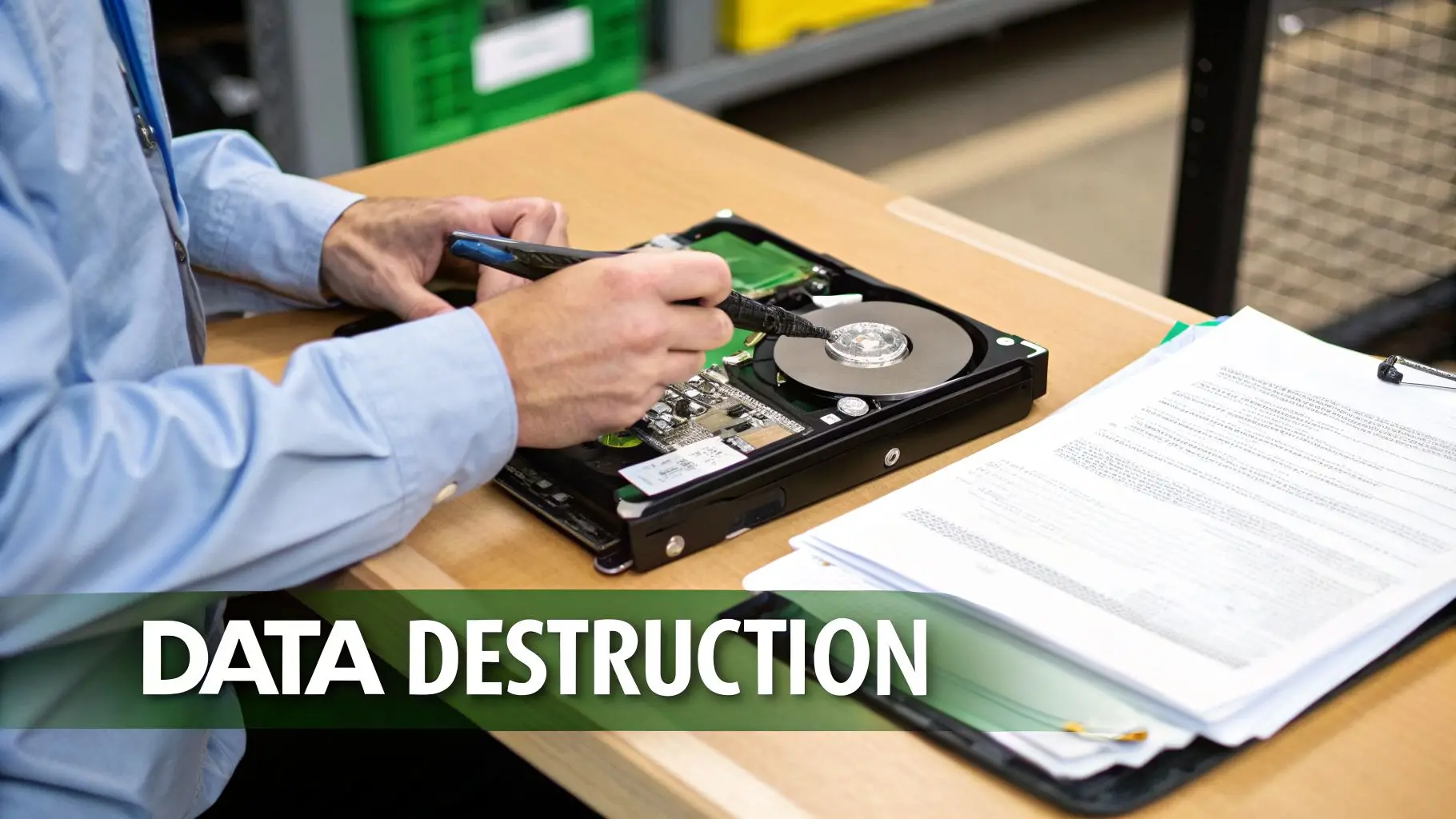
In IT asset disposal, nothing is more critical than eliminating data security risks. This is a matter of legal and financial necessity for any commercial enterprise.
Retiring IT assets involves managing the sensitive data stored on those devices. Federal laws like HIPAA (healthcare), GLBA (finance), and the FTC Disposal Rule (consumer information) are not mere guidelines—they are strict, legally binding requirements.
A single lapse can result in a catastrophic data breach, leading to crippling fines and brand damage that can take years to repair.
The NIST Standard for Data Destruction
To meet these stringent legal requirements, your data destruction methods must be verifiable. The industry gold standard for this is the NIST SP 800-88, "Guidelines for Media Sanitization." This framework provides clear, risk-based guidance for destroying data across various media types.
Any reputable, certified ITAD partner aligns their services with these NIST guidelines. For businesses in Georgia, this means partnering with a vendor that provides a full spectrum of compliant destruction methods:
- Software Wiping (NIST Clear & Purge): This process uses certified software to overwrite data on hard drives multiple times. It is ideal for newer, functional equipment you intend to resell, as it sanitizes the data while preserving the asset's value.
- Degaussing (NIST Purge): This method utilizes a powerful magnet to erase the magnetic field on hard drives and tapes, rendering the device inoperable and the data unrecoverable.
- Physical Shredding (NIST Destroy): For the highest level of security, nothing surpasses physical destruction. Mobile shred trucks can come directly to your Georgia facility to shred hard drives, SSDs, and other media into irrecoverable fragments before your eyes.
The appropriate method depends on your internal security policy and the asset type. However, physical shredding offers the most absolute and visually verifiable form of data destruction. Discover more about how Beyond Surplus implements these services in our guide to data destruction services in Georgia.
Understanding Chain of Custody
While the destruction method is crucial, the chain of custody is equally important. This refers to the documented, unbroken trail that tracks your assets from the moment they leave your facility until their final disposition. It is the legal and logistical foundation of compliant IT disposal.
A weak link in this chain creates a significant security vulnerability. A robust chain of custody must include:
- Secure Logistics: Use of sealed, locked containers and GPS-tracked vehicles for transport.
- Scanned Inventory: Scanning and recording the serial numbers of all data-bearing assets at pickup.
- Secure Processing: Handling all assets within a controlled, access-restricted facility.
- Auditable Documentation: Providing a Certificate of Data Destruction that lists every asset serial number, legally transferring liability from your business to your ITAD partner.
Real-World Scenario: A Georgia-based hospital decommissions 150 workstations. An uncertified hauler picks them up, but one device is misplaced. Its hard drive contains thousands of patient records, resulting in a HIPAA violation, multi-million dollar fines, and a public relations crisis. Certified, serial-number-tracked destruction prevents this scenario entirely.
Meeting Local and Global Compliance Standards
For IT directors in regulated industries such as healthcare, finance, and government contracting, compliance extends beyond domestic regulations. Partnering with a Georgia-based ITAD provider helps ensure Basel Convention compliance for any potential international shipments, protecting you from penalties related to solid waste tracking updates effective in January 2026.
Services like on-site shredding and nationwide logistics simplify compliance for data centers and large enterprises. They also enable value recovery through IT buyback programs while actively supporting Georgia's circular economy.
Explore insights from the Georgia Recycling Coalition to understand how state-level initiatives are shaping responsible business practices. This comprehensive approach ensures your sustainable IT disposal in Georgia is secure and fully compliant with both current and future regulations.
Getting Paid for Your Retired IT Assets
For many Georgia businesses, decommissioning old IT hardware is viewed as a necessary expense. That pile of obsolete equipment is often seen as little more than a disposal cost.
However, an IT Asset Value Recovery (ITAVR) strategy, also known as an IT buyback program, can transform this cost center into a revenue stream. Instead of paying to dispose of your hardware, you can get paid for it.
What Kind of Equipment Has Resale Value?
The first step is identifying which assets retain value on the secondary market. The key factors are not just age, but also demand, functionality, and cosmetic condition.
Assets that typically yield the best returns in a buyback program include:
- Enterprise-Grade Laptops and Desktops: Business-class models from brands like Dell, HP, and Apple, particularly those less than five years old.
- Servers and Networking Gear: Functional servers, switches, and routers from manufacturers like Cisco, Dell, and HPE often retain significant value.
- Specialized Equipment: Certain types of hardware from data centers, laboratories, or medical facilities can be in high demand.
As a general rule, if an asset is less than five years old, fully functional, and in good cosmetic condition, it likely has residual value. Even individual components like CPUs and RAM can be harvested and resold.
How the Value Recovery Process Works
When you partner with a professional ITAD provider like Beyond Surplus, the value recovery process is secure and transparent, designed to maximize your return while guaranteeing data destruction.
Here’s what you can expect:
First, you provide your ITAD partner with an inventory list of the assets being retired, including make, model, specifications, and quantities.
Based on this list, the vendor analyzes current market data and provides a preliminary quote. This outlines the potential buyback value for your equipment, giving you a clear expectation upfront.
Upon approval, a secure pickup is scheduled. At the processing facility, every asset is audited, tested, and graded. Crucially, every data-bearing device undergoes a certified data destruction process compliant with NIST 800-88 standards.
After processing is complete, you receive a final, detailed report itemizing the value recovered from each asset. Your company then receives a check or account credit. A disposal cost has now become a new revenue stream.
This strategy makes sustainable IT disposal in Georgia not only an environmental responsibility but also a smart financial decision that directly benefits your bottom line.
Mastering Disposal Logistics Across Georgia
Transporting your old IT assets from your office to a secure processing facility is a critical phase of the disposal process. For businesses across Georgia—from Atlanta high-rises to Savannah manufacturing plants—logistics are just as important as data destruction. Partnering with a Georgia-based provider offers significant advantages.
A local partner provides faster, more flexible scheduling. A provider with a fleet of GPS-tracked trucks can respond quickly, whether you have a single pallet of laptops or require a full truckload removal for a data center decommissioning. This also reduces transportation costs and minimizes your carbon footprint.

Finding a Service That Fits Your Business
Every business in Georgia has unique operational needs, and a one-size-fits-all approach to IT disposal is ineffective. A quality certified partner understands this and offers flexible service models.
Common service options for commercial clients include:
- Scheduled Pickups: Ideal for large companies with multiple offices, ensuring equipment is removed regularly to prevent accumulation and maintain a streamlined disposal process.
- On-Demand Services: Perfect for major projects like data center migrations, office relocations, or large-scale technology refreshes that generate a high volume of equipment at once.
- Local Drop-Off: A convenient option for smaller businesses or those with less frequent disposal needs near metropolitan hubs like Atlanta, providing the same secure service without a dedicated pickup.
The need for these professional services is growing. In 2014, Georgia was already generating 21,000 tons of e-waste annually. With 31% of households admitting to stockpiling old electronics and 20% discarding them in the trash, it is clear that businesses require a more secure and responsible solution. You can review the full e-waste flow analysis in Georgia to see the scale of the challenge.
A Real-World Example of Smart Logistics
Consider a large Georgia university undergoing a campus-wide technology upgrade, tasked with retiring thousands of computers, monitors, and laboratory equipment. Instead of attempting to manage this complex project internally, the facilities team partnered with a certified ITAD vendor.
The university required a partner who could coordinate pickups across more than a dozen buildings on a strict schedule, shred hard drives on-site to protect student data, and provide a complete audit trail for every asset.
The vendor's local fleet implemented a phased pickup plan that avoided disruption to classes and campus operations. On-site shredding provided the university with immediate confirmation that sensitive data was destroyed. Ultimately, the university successfully diverted tons of e-waste from landfills, received all necessary compliance documentation, and recovered significant value from newer laptops through a buyback program.
This project demonstrates how the right logistics partner can transform a massive operational headache into a secure, streamlined, and successful initiative. It all comes down to choosing a provider with deep local expertise. To learn more, see our guide on electronics recycling pickup services in Georgia.
Answering Your Georgia IT Disposal Questions
Navigating the world of IT asset disposal can be complex, and it is natural for Georgia businesses to have questions. Here are direct answers to some of the most common inquiries we receive from commercial clients, providing the straightforward information you need to manage your end-of-life technology securely and responsibly.
What Is The Difference Between R2 And e-Stewards Certification?
When vetting an ITAD partner, you will frequently encounter R2 and e-Stewards certifications. Both are premier, third-party standards for the electronics recycling industry. Choosing a vendor with either certification is a strong indicator of their commitment to security and environmental stewardship.
However, they have slightly different origins and areas of emphasis.
- R2 (currently R2v3): This is a comprehensive, risk-management-based standard. It covers the entire lifecycle, including environmental protection, worker health and safety, data security, and the vetting of downstream vendors. It focuses on creating robust, documented, and auditable processes.
- e-Stewards: This standard is renowned for its unequivocal ban on exporting hazardous e-waste to developing countries. It was created by the Basel Action Network to prevent the environmental and human health crises caused by improper recycling practices abroad.
For your business in Georgia, the key takeaway is that a partner holding either R2v3 or e-Stewards certification has passed rigorous independent audits. This certification is your best assurance against data breaches and environmental liability.
How Do I Know If My Old Equipment Has Any Buyback Value?
One of the most valuable aspects of professional ITAD is that retired equipment is often a recoverable asset, not just a disposal cost. Many businesses are surprised to learn they can receive payment for their used technology.
Generally, equipment that is less than five years old, in good working condition, and from major enterprise brands like Dell, HP, Apple, or Cisco has the highest potential for a buyback offer.
Common items with strong resale value include:
- Enterprise-grade laptops and desktops
- Servers and networking switches
- High-end monitors and workstations
- VoIP phones and other communication hardware
The only definitive way to know is to request a professional evaluation. A certified ITAD vendor can assess your inventory against current secondary market values and provide a fair quote, turning a perceived cost into a positive return on investment.
What Documentation Should I Expect From My ITAD Vendor?
The documentation you receive after an ITAD project is your legal proof of due diligence. It demonstrates that you have met your obligations to protect sensitive data and manage e-waste in accordance with laws like the FTC Disposal Rule.
Without this documentation, your business remains exposed to potential liability.
You should always receive two critical documents upon project completion:
- Certificate of Data Destruction: This is your official certification that all data was destroyed in accordance with NIST 800-88 standards. For maximum legal defensibility, it should list the serial numbers of the devices and the specific destruction method used.
- Certificate of Recycling: This document verifies that all non-data-bearing assets were recycled in an environmentally responsible manner.
These certificates formally transfer liability from your company to your ITAD vendor. Ensure you archive them with your permanent compliance records. To understand the full process, you may find it helpful to read our guide that answers the question, "What is IT Asset Disposition?"
Can You Provide Pickups For Businesses Outside Of Atlanta?
Yes. While Atlanta is a major commercial hub, any established Georgia ITAD company should serve businesses across the entire state. Reputable partners operate their own secure logistics networks and fleets to schedule pickups for commercial clients statewide.
Whether your business is located in Savannah, Augusta, Macon, Columbus, or a smaller community, a professional vendor can coordinate a secure pickup tailored to your schedule. When vetting potential partners, simply confirm their service area to ensure they can accommodate your location(s). This statewide capability is essential for any organization with a distributed footprint in Georgia.
For a professional, secure, and compliant solution to your commercial IT disposal needs, Beyond Surplus offers certified services for businesses across Georgia and the entire United States. Contact us today for a free assessment and ensure your assets are managed responsibly.