For businesses in Georgia, a strategy for sustainable electronics recycling is a core component of corporate responsibility and risk management. Properly managing retired IT assets is a non-negotiable task that protects your data, bolsters your brand reputation, and can generate a financial return. This guide is designed for IT managers, facility managers, and business owners seeking compliant and efficient commercial electronics disposal solutions.
Why Georgia Businesses Need A Sustainable ITAD Strategy
Managing retired technology is far more than simple disposal. For commercial and enterprise entities across Georgia—from tech firms in Atlanta to manufacturing operations in Savannah—a formal IT Asset Disposition (ITAD) program is a business necessity. This shift is driven by stricter data privacy laws, client demands for corporate responsibility, and a sharp awareness of the environmental impact of electronic waste.
A professional ITAD strategy converts a potential liability—such as unsecured, obsolete equipment—into a secure, structured, and profitable process. It covers the entire asset lifecycle after decommissioning, ensuring every step is handled with precision and full accountability.
The E-Waste Challenge in a Commercial Context
The global scale of e-waste underscores the need for professional recycling services. In 2022, the world generated an incredible 62 million tonnes of e-waste, an 82% increase from 2010. Projections show this figure climbing another 32% to 82 million tonnes by 2030, driven by rapid technology refresh cycles and shorter device lifespans. For Georgia businesses, improperly disposed-of electronics not only pose environmental hazards but also create significant data security and compliance risks.
A forward-thinking ITAD program is not a cost center; it's an investment in risk mitigation, brand integrity, and operational efficiency. It’s about proactively managing the end of the IT lifecycle to protect and benefit the entire organization.
This proactive approach ensures your company is not merely checking a compliance box. You are actively turning a potential vulnerability into a strategic advantage, demonstrating a commitment to sustainability that customers, partners, and investors value.
From Liability To Strategic Asset
A well-executed ITAD program offers measurable benefits that impact multiple facets of your business operations. It’s about being secure, compliant, and financially astute. A robust ITAD strategy integrates key drivers that directly affect a company's bottom line and reputation.
Key Drivers for Sustainable ITAD for Georgia Businesses
| Business Driver | Primary Concern | Strategic Benefit |
|---|---|---|
| Data Security & Privacy | Avoiding costly data breaches and leaks from retired hardware. | Protects sensitive corporate and client data, ensuring compliance with regulations like the FTC Disposal Rule and HIPAA. |
| Environmental Responsibility | Preventing toxic e-waste from entering landfills and harming the ecosystem. | Boosts brand reputation and helps meet Environmental, Social, and Governance (ESG) goals, attracting conscious partners and investors. |
| Financial Returns | Recovering value from depreciated but still functional IT equipment. | Creates a revenue stream through the remarketing of refurbished assets, helping to offset new technology acquisition costs. |
| Operational Streamlining | Freeing up internal IT staff from the complexities of asset disposal. | Allows IT and facilities teams to focus on core business functions instead of managing logistics, data destruction, and recycling compliance. |
By transitioning from a reactive disposal mindset to a proactive, strategic approach, businesses can unlock significant value while ensuring responsible operation. Partnering with a certified specialist for sustainable electronics recycling in Georgia provides the confidence that every retired asset is managed securely, responsibly, and with a focus on maximizing its residual value.
Navigating The Compliance Maze In Georgia
For any commercial entity in Georgia, disposing of outdated IT equipment is more complex than simply clearing out a storage room. A web of federal and state regulations governs this process, and non-compliance can lead to substantial fines, legal action, and reputational damage. The primary objectives of these regulations are to prevent hazardous materials from contaminating the environment and to ensure sensitive data does not fall into the wrong hands. Understanding these obligations is the first step toward a defensible disposal plan.
Key Federal Regulations To Know
Several key federal laws establish the framework for electronics disposal and apply directly to businesses in Georgia. These are not mere guidelines; they are legally enforceable mandates.
Two of the most significant regulations include:
- Resource Conservation and Recovery Act (RCRA): This is the principal federal law governing solid and hazardous waste. Many electronic components, such as CRT monitors containing lead and circuit boards with heavy metals, can be classified as hazardous waste, making their disposal in municipal landfills illegal.
- FTC Disposal Rule: This regulation focuses on data security. The Federal Trade Commission requires businesses to take "reasonable measures" to protect customer information during disposal. Simple file deletion is insufficient; the FTC mandates secure and permanent data destruction.
These laws set a clear standard for corporate responsibility. Ignoring them constitutes a direct compliance violation that can attract regulatory scrutiny.
The Critical Role Of Chain Of Custody
The concept of chain of custody is paramount. It refers to the documented, unbroken trail that tracks your assets from the moment they leave your facility to their final disposition—be it recycling, resale, or destruction. A single gap in this chain can redirect liability back to your organization, even if a third-party vendor was contracted for the service.
A detailed chain of custody report is your proof of due diligence. It demonstrates that you took every necessary step to ensure your assets and the data they contained were handled securely and responsibly, effectively transferring liability to your certified ITAD partner.
This documentation serves as your primary defense in an audit. It should track each asset by its serial number, confirming every stage of its journey from secure transit to final data destruction.
Industry-Specific Compliance Scenarios
Different industries in Georgia face unique compliance pressures based on the type of data they handle. A one-size-fits-all approach to data destruction is inadequate.
Consider these commercial scenarios:
- Healthcare in Atlanta: A hospital system upgrading patient monitoring devices must ensure all Protected Health Information (PHI) is destroyed in a HIPAA-compliant manner. A Certificate of Data Destruction, tied to each device's serial number, is mandatory.
- Finance in Alpharetta: An investment firm retiring servers that held client financial data must comply with the Gramm-Leach-Bliley Act (GLBA). On-site hard drive shredding is often chosen to ensure maximum security before the equipment leaves the premises.
- Legal in Savannah: A law practice replacing attorney laptops must protect sensitive client communications covered by attorney-client privilege. This requires certified data erasure that meets rigorous Department of Defense standards.
The e-waste recycling market, valued at USD 43.2 billion, is projected to reach USD 147.9 billion by 2035. This growth is fueled by regulations like RCRA and a push for stronger state laws, making compliance more critical than ever. For a deeper analysis of local regulations, review our guide on compliant IT disposal in Georgia.
Implementing A Secure IT Asset Disposition Process
Moving from theory to practice, a structured IT Asset Disposition (ITAD) process is the operational playbook for recycling electronics securely and maintaining legal compliance. This methodical approach ensures every retired asset is handled correctly from the moment it is decommissioned. The objective is to build a clear, repeatable, and defensible system that protects your business at every stage. The process begins with a crucial first step: a comprehensive asset inventory.
Starting With An Accurate Asset Inventory
Before any equipment leaves your premises, a precise record of all items designated for disposal must be created. A detailed inventory is the foundation of a secure chain of custody. Without it, you cannot prove what was destroyed or recycled, leaving your business vulnerable during an audit. The goal is to capture essential information for tracking and compliance.
Your inventory should include these key data points:
- Asset Tag Number: Your company's internal identifier for the equipment.
- Device Type: (e.g., Laptop, Server, Desktop, Network Switch).
- Manufacturer and Model: (e.g., Dell Latitude 7420, Cisco Catalyst 9300).
- Serial Number: The unique manufacturer-assigned identifier, critical for all subsequent documentation.
This inventory list becomes the master document against which all subsequent paperwork, including Certificates of Data Destruction, is reconciled. It is your first and most important line of defense.
The Critical Data Destruction Phase
With the inventory complete, the next priority is ensuring the permanent erasure of all sensitive data. Simply deleting files or formatting a hard drive is insufficient, as data can often be recovered. For any Georgia business, inadequate data destruction is not just a security risk; it is a direct violation of regulations such as the FTC Disposal Rule.
There are three primary methods for certified data destruction, each suited to different security requirements and asset types:
- Data Wiping (Sanitization): Specialized software overwrites the entire hard drive with random data, rendering the original information unrecoverable. This method meets standards like Department of Defense (DoD 5220.22-M) and is ideal for functional drives intended for resale, maximizing value recovery.
- Degaussing: This technique uses a powerful magnetic field to destroy the magnetic domains on a hard drive or magnetic tape, instantly erasing all data. It is fast and effective but renders the drive permanently unusable.
- Physical Shredding: For the highest level of security, physical destruction is the definitive solution. Hard drives are fed into an industrial shredder that grinds them into small metal fragments. This is the gold standard for devices containing highly sensitive intellectual property, financial records, or patient health information.
The flowchart below illustrates how compliance requirements can determine the necessary level of data destruction for your organization.
As shown, your industry dictates your data security protocols. Whether governed by RCRA for waste, the FTC for consumer data, or HIPAA for health information, your data destruction approach must align with the associated risk.
Logistics And Secure Transit
The transportation of your assets from your facility to the processing center is a critical and often overlooked link in the security chain. A reputable ITAD partner will provide secure, documented logistics, including locked trucks, sealed pallets, and professional staff trained in handling sensitive IT equipment. Upon arrival at a certified facility like Beyond Surplus, assets are immediately moved to a secure, access-controlled area. Your initial inventory is then reconciled against the received equipment, and any discrepancies are immediately reported.
Once inside the facility, every single device is tracked by its serial number throughout the entire process—from data destruction and testing all the way to final recycling or resale. This creates a transparent and auditable trail from start to finish.
Final Documentation: The Compliance Linchpin
The ITAD process concludes not when the equipment is removed, but when you receive the final documentation. This paperwork is your legal proof of compliance, formally transferring liability from your organization to your certified vendor.
Your documentation package must include:
- A Detailed Asset Report: A final list of every processed item, cross-referenced with your initial inventory.
- A Certificate of Data Destruction: The most critical document, listing the serial numbers of all data-bearing media that were sanitized, degaussed, or shredded, and certifying the method used. Learn more about why a detailed hard drive certificate of destruction is essential.
- A Certificate of Recycling: Confirms that all non-functional assets were processed in an environmentally responsible manner, adhering to all relevant regulations.
This documentation should be archived as definitive proof of compliance for any future audits or security inquiries.
Turning Retired IT Assets Into Revenue
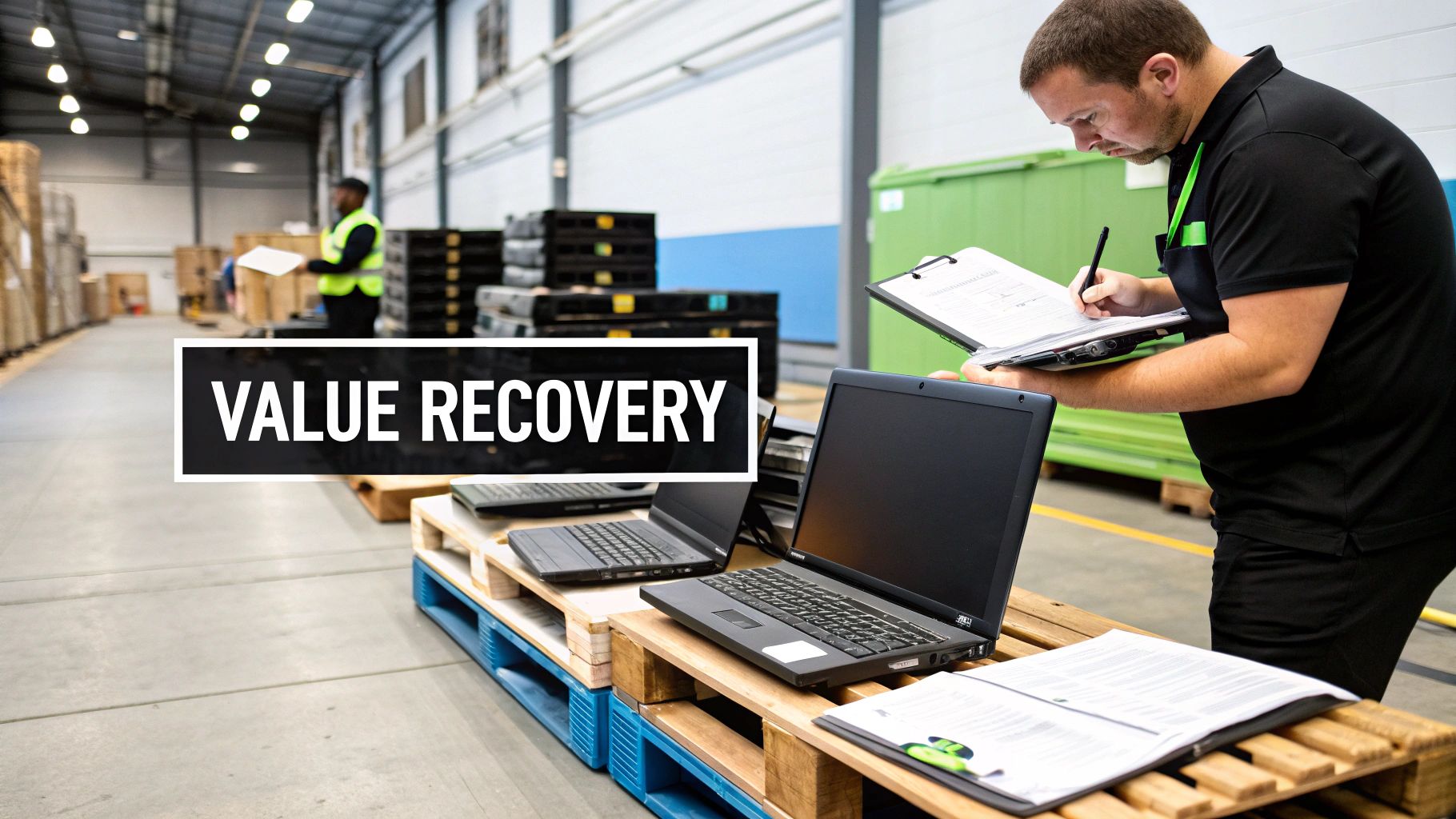
A common misconception among Georgia businesses is that IT disposal is solely an expense. However, with a strategic approach, your end-of-life IT assets can be transformed from a costly liability into a valuable revenue source. This requires shifting from a simple disposal mindset to one of smart value recovery. A professionally managed IT buyback program is designed to identify and capture the remaining market value in your retired equipment.
Identifying Assets With High Resale Potential
Not all retired equipment holds significant value. A successful buyback program hinges on identifying assets with remaining functionality and appeal on the secondary market. An experienced partner can quickly assess your inventory, but generally, the highest returns come from devices that are functional, in good cosmetic condition, and not technologically obsolete.
Assets that typically retain the most value include:
- Laptops and Desktops: Enterprise-grade models from manufacturers like Dell, HP, and Lenovo, particularly those less than five years old, are consistently in demand.
- Servers and Networking Gear: Rack servers, switches, and routers from brands like Cisco, Dell, and HPE often retain substantial value.
- Enterprise Storage Systems: SAN and NAS units from leading manufacturers can be highly valuable if they are in good working condition.
- Specialized Equipment: Certain medical, laboratory, or manufacturing devices also have robust secondary markets.
The goal is simple: separate the equipment that can be remarketed from the true recycling stream. This one act of sorting can directly boost your bottom line, turning what would have been recycling fees into a check coming back to your business.
How Simple Steps Maximize Your Financial Return
Proactive measures taken before your assets leave your facility can significantly increase their financial return. While a certified ITAD partner handles the refurbishment and remarketing, your team can help preserve asset value. For instance, keeping original power adapters with their corresponding laptops can boost their resale value. Ensuring devices are free from physical damage—such as cracked screens or dented casings—makes them more attractive to buyers. A well-maintained asset is a more valuable one.
The Professional Buyback And Remarketing Process
Upon arrival at a certified partner like Beyond Surplus, a transparent and methodical process begins. This is not simply about liquidating old equipment; it is a detailed operation designed to secure the best possible price while guaranteeing data security. Our specific approach to maximizing returns is outlined in our dedicated asset recovery services in Georgia.
The professional process includes:
- Detailed Auditing and Testing: Each asset is functionally tested and assigned a cosmetic grade.
- Secure Data Sanitization: All data-bearing devices are wiped according to NIST 800-88 standards, preserving the hardware's usability and value.
- Strategic Remarketing: The ITAD partner leverages established sales channels to find appropriate buyers and secure fair market value.
- Transparent Reporting: You receive a detailed settlement report showing the sale price of each item and a clear breakdown of the revenue share.
This professional approach aligns with a major global trend. The ITAD sector is projected to reach $36.4 billion by 2034, driven by factors such as mass cloud migrations. This growth confirms that strategic, sustainable ITAD not only manages risk but also enhances the bottom line in a market where unrecycled e-waste represents billions in lost value. You can read more about these major market shifts and see how your business can benefit from investment recovery trends in the ITAD space.
Selecting The Right ITAD Partner In Georgia
Choosing an IT Asset Disposition (ITAD) partner is a critical decision in your electronics recycling strategy. A qualified partner acts as an extension of your IT and compliance teams, protecting your data and corporate reputation. Conversely, an unsuitable vendor can expose your organization to significant risks, including data breaches and environmental fines. The selection process should be based on verifying a partner's security, compliance, and operational integrity.
Certifications Are Your First Line of Defense
In the field of sustainable electronics recycling in Georgia, third-party certifications are the baseline for establishing trust. These credentials are not easily obtained; they require vendors to undergo rigorous, ongoing audits of their entire operation, from receiving to final disposition.
The two premier certifications to look for are:
- R2v3 (Responsible Recycling): This is the leading global standard for electronics recyclers, covering environmental protection, worker health and safety, data security, and the complete downstream tracking of all materials. An R2v3 certified facility has proven its processes are safe, secure, and environmentally sound.
- e-Stewards: Developed by the Basel Action Network, this standard places a strong emphasis on preventing the illegal export of hazardous e-waste to developing countries. It is another top-tier certification that guarantees responsible management throughout the recycling chain.
When a potential partner holds these certifications, it provides assurance that they operate under a documented, audited system. You can learn more about R2 certification to understand why it is crucial for protecting your business.
Critical Questions to Ask Any Potential Vendor
After confirming a vendor's certifications, a deeper evaluation is necessary. Direct conversations and a facility tour are invaluable for assessing their operations. Look for complete transparency, professionalism, and clear, confident answers to your questions.
A trustworthy ITAD partner will welcome your questions and be eager to show you their facility. Hesitation or vague answers about their processes should be considered a major red flag.
The following checklist can guide your evaluation and help you differentiate qualified partners from unqualified vendors.
Vetting Your Georgia ITAD Partner Checklist
Use this guide to ask targeted questions that assess a vendor's capabilities, ensuring they meet your business's high standards for security, compliance, and sustainability.
| Evaluation Criteria | What to Look For | Why It Matters |
|---|---|---|
| Data Security Protocols | Do they offer on-site shredding? What software do they use for data wiping (e.g., NIST 800-88 compliance)? | Confirms they can meet your specific security requirements and protect you from a data breach. |
| Downstream Accountability | Can they provide a complete downstream vendor map showing where all materials go after processing? | Verifies they are not exporting hazardous e-waste and have a transparent, ethical recycling chain. |
| Insurance Coverage | Ask for proof of general liability, errors and omissions, and pollution liability insurance. | Protects your organization from financial loss in the rare event of a data breach or environmental incident. |
| Chain of Custody | What does their documentation process look like? Do they provide serialized reporting from pickup to final destruction? | A robust, serialized chain of custody is your legal proof of due diligence and is essential for compliance audits. |
| Facility Security | During a tour, look for access controls, 24/7 camera surveillance, and secure, segregated areas for processing. | Physical security is just as important as digital security. It ensures your assets are protected from theft or loss. |
By asking these pointed questions, you can move beyond marketing claims and assess the true substance of a vendor's operations. The goal is to find a partner who will handle your assets—and the sensitive data they contain—with the same level of care as your own organization.
Got Questions About Business E-Waste Recycling? We’ve Got Answers.
Even with a solid plan, handling end-of-life IT assets always brings up a few questions. For busy IT managers and business owners in Georgia, getting straight, practical answers is key. Here are some of the most common questions we hear, with quick insights to help you navigate electronics recycling with confidence.
What's the Real Difference Between "Electronics Recycling" and "ITAD"?
While often used interchangeably, these terms describe different levels of service. Understanding the distinction is vital for protecting your business.
Electronics recycling is fundamentally about material recovery. Its primary goal is to dismantle old devices to reclaim valuable commodities like copper, gold, and aluminum, thereby diverting hazardous materials from landfills.
IT Asset Disposition (ITAD) is a comprehensive, security-focused business process. While it includes certified recycling, it incorporates additional critical layers:
- Rock-Solid Data Security: ITAD prioritizes certified data destruction to eliminate the risk of a data breach.
- Value Recovery: It focuses on identifying and capturing the residual value in used equipment through testing and remarketing, which can generate revenue for your company.
- Compliance & Reporting: A true ITAD partner provides a complete audit trail—including Certificates of Destruction and serialized reports—to document compliance and transfer of liability.
In short, recycling is a task, whereas ITAD is a complete strategy that transforms a disposal challenge into a secure, compliant, and potentially profitable process.
Are Professional ITAD Services Really Necessary for a Small Business?
Absolutely. Data security and compliance obligations apply to businesses of all sizes. A data breach can be particularly devastating for a small or medium-sized business in Georgia. Even a few retired laptops or a single server can contain sensitive information, such as client lists, financial records, or employee PII.
Liability doesn't shrink just because your company is smaller. Professional ITAD services are built to be scalable, offering the same high-level certified data destruction and responsible recycling to businesses of all sizes. You get the same protection, whether you have five assets or five hundred.
Engaging a professional partner is a proactive measure to ensure your business is not exposed to significant financial and reputational risks.
What Kind of Paperwork Should I Expect From My Recycling Partner?
Proper documentation is the foundation of a defensible ITAD program. This paperwork serves as your official proof of responsible action and the legal transfer of liability for the assets to your certified partner.
From any certified provider, you should always receive a complete documentation package that includes:
- Certificate of Data Destruction: This is non-negotiable. It must list the serial numbers of all data-bearing devices that were sanitized or physically destroyed and specify the exact destruction method used.
- Certificate of Recycling: This document confirms that all non-functional assets were processed in full compliance with all federal, state, and local environmental regulations.
- Serialized Inventory Report: A final, detailed report listing every asset processed. This report should align perfectly with the inventory list created before the equipment left your facility.
Can You Handle Our Specialized Medical or Lab Equipment?
Yes, a full-service ITAD provider is equipped to manage more than standard office equipment. Industries such as healthcare, manufacturing, and scientific research have specialized equipment and are subject to strict data privacy regulations like HIPAA.
A qualified partner will have demonstrated expertise in securely sanitizing and responsibly recycling a wide range of specialized devices, including patient monitoring systems, diagnostic imaging machines, and sensitive laboratory instruments. They will be knowledgeable about industry-specific compliance standards and ensure all components, including any hazardous materials, are managed correctly.
Contact Beyond Surplus for certified electronics recycling and secure IT asset disposal. We provide compliant ITAD solutions for businesses in Georgia, designed to protect your data, maximize asset value, and ensure environmental responsibility. Contact us today to schedule a secure pickup and develop a comprehensive disposition plan tailored to your commercial needs.