Your business just finished a refresh cycle. Now the old laptops are stacked in a storage room, the monitors are leaning against a wall, and the retired servers still hold data your team cannot afford to mishandle. A fast search for “recycling locations near me” pulls up plenty of results, but most of them are built for household drop-offs, not for a company with compliance exposure.
That distinction matters. The wrong outlet may be convenient, but convenience is not the same as chain of custody, serialized reporting, or certified destruction. If drives leave your site without documentation, your company still owns the risk. If equipment gets dropped into a consumer collection stream, your audit trail may end the moment it leaves your loading dock.
Minnesota’s numbers make the business case clearly. In 2021, recycling programs in the state collected about 1.781 million tons of material worth $344 million, and the sector supported about 78,000 jobs while contributing nearly $23.9 billion to the state economy and generating $7.96 billion in wages, according to the Minnesota Pollution Control Agency’s recycling in Minnesota data. At the same time, recyclable material still went to landfill, which tells you the gap is not awareness alone. It is execution.
For business managers, the right question is not just where the nearest recycler is. The essential question is which option fits the asset class, the data risk, and the documentation your auditors will expect. If your marketing team also cares about ranking higher in 'near me' searches, the same principle applies operationally. Local visibility is useful, but fit matters more than proximity.
1. Beyond Surplus
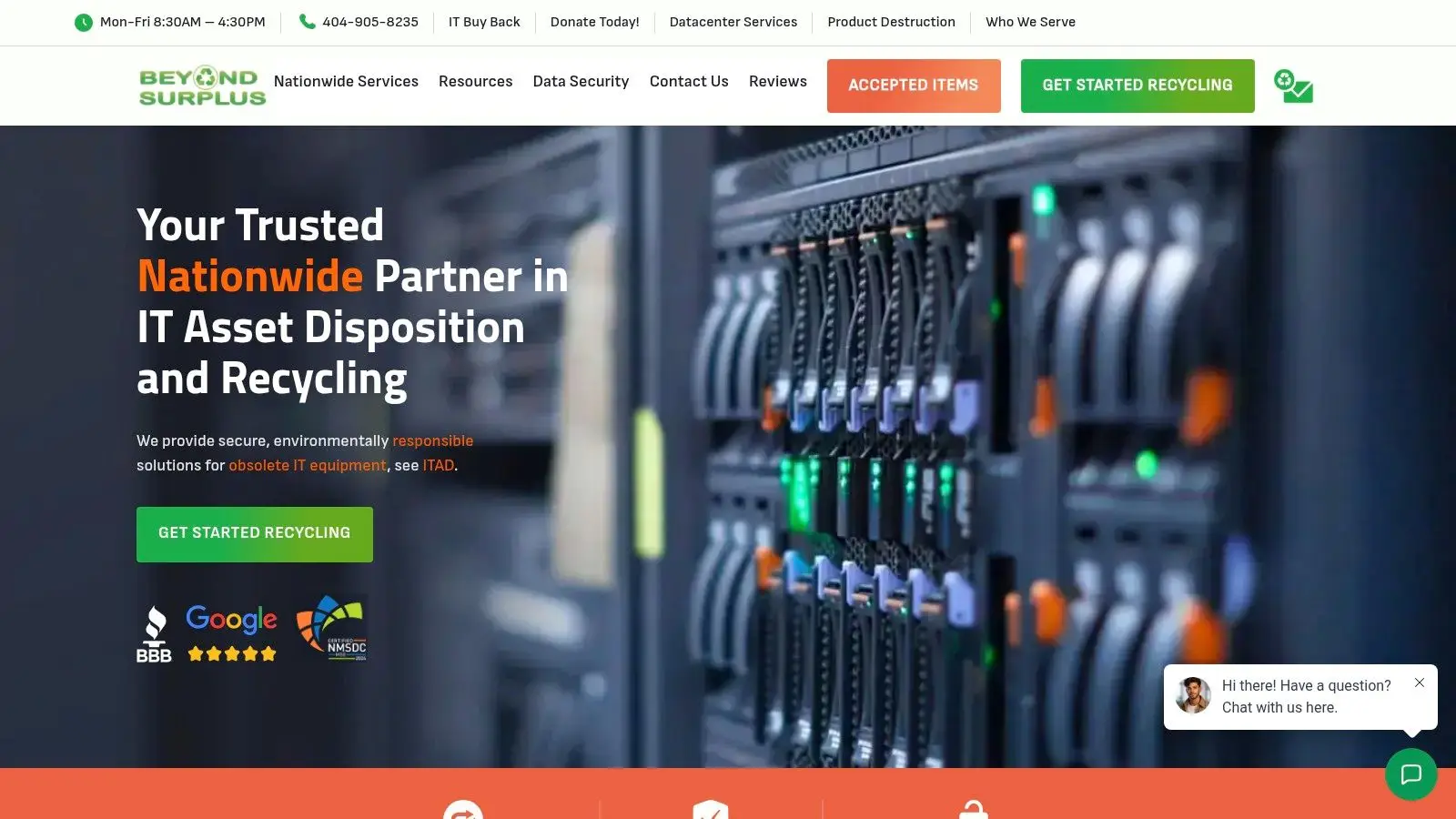
Beyond Surplus is the option I would put at the top for businesses that need secure electronics recycling, IT asset disposition, and real documentation instead of a simple drop-off receipt. It is built for commercial work. That changes the conversation from “where can I take this?” to “how do I remove risk, recover value, and close the project correctly?”
The company is Atlanta-based, serves organizations nationwide across the contiguous U.S., and handles both on-site and off-site hard drive shredding, certified data wiping, recycling, buyback, de-installation, palletizing, and pickup logistics. That combination matters because most “recycling locations near me” results solve only one piece of the job.
Why it stands out for business use
Beyond Surplus is strongest when the project includes any mix of these conditions: regulated data, multiple asset types, pickup needs, chain-of-custody requirements, or pressure to clear space fast.
Best fit: Businesses, schools, healthcare groups, financial organizations, manufacturers, and data center teams
What works well:
Certified destruction: On-site or off-site options give IT and compliance teams flexibility.
Documentation: Certificates of recycling and data destruction support audit trails and liability transfer.
Operational support: Pickup, de-installation, and handling reduce the burden on internal staff.
Value recovery: The IT buyback program can help offset retirement costs on reusable equipment.
Trade-off: You will need a quote. Pricing depends on item mix, quantity, and service scope.
If you have pallets of mixed equipment, ask about shredding, wiping, and resale in the same scope. Splitting those services across vendors usually creates reporting gaps.
A practical strength here is that Beyond Surplus does not force you into a one-size-fits-all disposal path. Some assets should be destroyed. Some should be wiped and remarketed. Some should go straight to downstream recycling. That is the workflow most business teams encounter. Their own guide on what to look for in recycling center options is worth reviewing before you choose any vendor.
2. Best Buy Electronics & Appliances Recycling
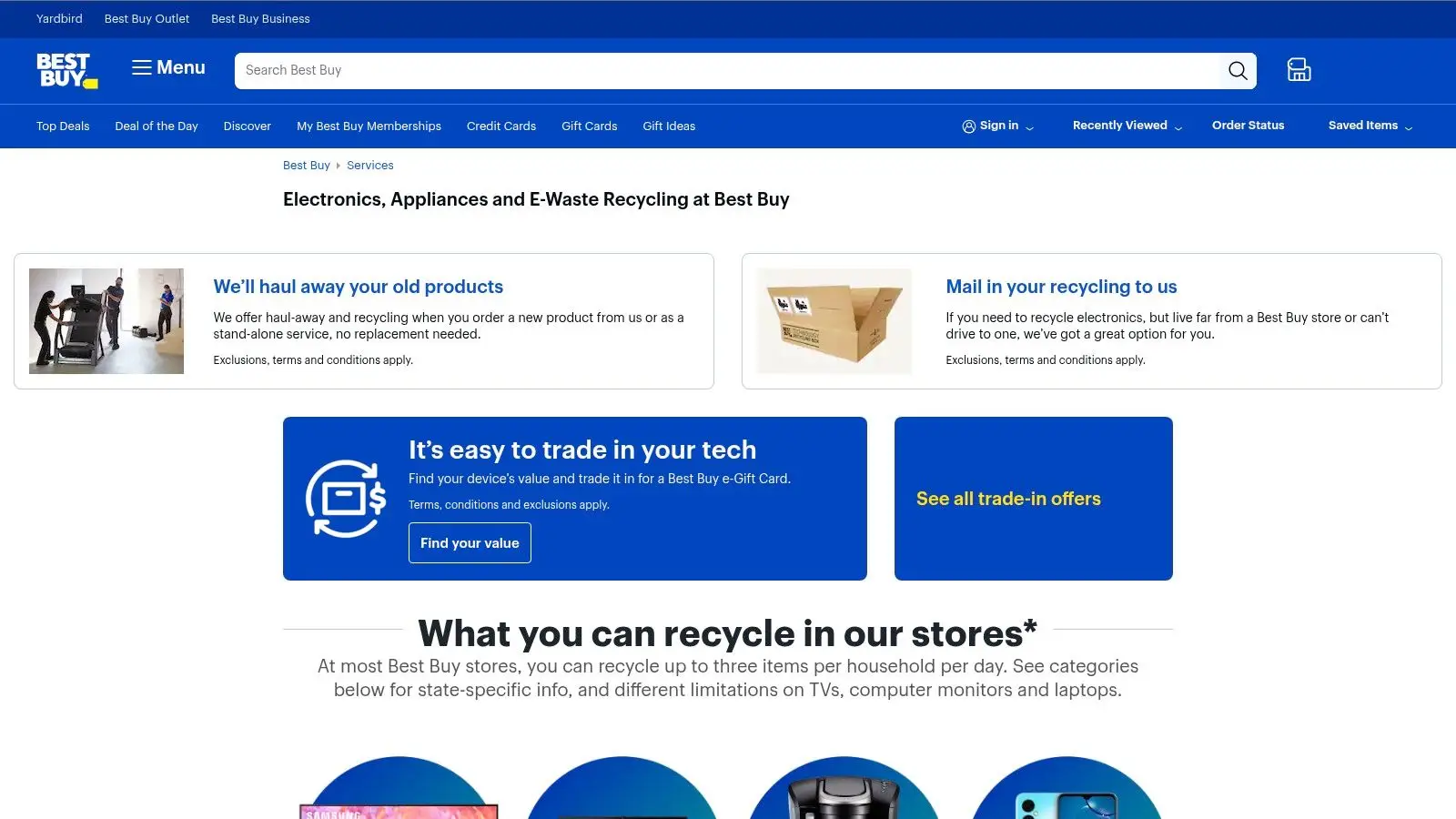
Best Buy is one of the most familiar answers to “recycling locations near me,” and that is exactly why businesses should evaluate it carefully. It is convenient. It is visible. It is not an enterprise ITAD workflow.
For a very small office clearing a few accessories, keyboards, or end-user devices, retail collection can be useful. The online acceptance lists are straightforward, and many teams already have a store nearby. If your priority is basic convenience, Best Buy earns its place on the shortlist.
Where it fits and where it falls short
The strength is the store footprint and the predictable walk-in experience. The weakness is documentation depth.
Good use case: A small office with a handful of low-risk items and no need for serialized destruction records.
Less suitable: Server gear, storage media, bulk refreshes, regulated data, or any project requiring a clean chain of custody from pickup through final processing.
Best Buy can make sense for simple retail-style recycling, but business managers should not confuse a consumer collection model with compliance support. If your assets contain storage, customer data, employee records, or financial information, this route is usually too light on controls.
3. Staples Free Tech Recycling

Staples is another easy answer when teams search for nearby electronics recycling. The program is simple. Walk in, hand over eligible items, and move on. For clutter reduction, that works. For asset disposition, it is limited.
The practical issue is not whether Staples can accept some electronics. It is whether the service matches your internal control requirements. For many businesses, the answer is no.
Practical trade-offs
Staples is useful when the project is small and the stakes are low. Think retired mice, cables, old peripherals, and a few workstations that have already been sanitized internally.
What works:
Fast drop-off: Good for office managers handling a small volume.
Broad familiarity: Most staff already understand the retail process.
Convenient locations: Often easier than scheduling a special trip.
What does not:
No strong audit layer: Retail counters are not built around enterprise asset tracking.
Volume constraints: Large refreshes quickly outgrow the model.
Weak fit for storage devices: If drives are involved, retail convenience stops being the deciding factor.
For teams sorting through older endpoints, Beyond Surplus has a more business-focused resource on how to recycle a computer without losing sight of security and documentation.
4. Goodwill + Dell Reconnect

Goodwill + Dell Reconnect is often a solid answer for individuals looking to pass along computer equipment through a familiar nonprofit channel. That consumer orientation is the key point. It is a helpful community-facing program, but it is not structured like an enterprise chain-of-custody service.
For a business manager, the appeal is easy local access. The concern is scope. Programs like this usually fit small, straightforward computer-related drop-offs better than mixed commercial loads.
The business view
If your company has a few non-sensitive items and wants a quick local outlet, this may be adequate. If you are handling laptops with retained storage, network gear, or anything from a regulated environment, you need more control than a donation-style workflow normally provides.
I would classify this as a personal or very small office option, not a primary outlet for managed business disposition. It helps divert equipment from disposal, but it does not replace a certified ITAD partner when legal, security, or reporting obligations are in play.
5. Call2Recycle Battery Drop-off Network
Battery recycling is where many office cleanouts go sideways. Teams box up laptops, docks, and phones, then forget the loose batteries in desk drawers and supply cabinets. Those batteries need their own process.
Call2Recycle is useful because it solves a narrow problem well. It gives businesses and staff a way to locate battery drop-off sites without pretending to be a full electronics recycling provider.
Best used as a companion option
This is not where you send your whole IT refresh. It is where you route batteries that should never be tossed into general recycling streams.
Best use: Managing loose rechargeable batteries and similar power cells that sit outside the main asset-disposition workflow.
Limitations:
Batteries only: It does not replace your electronics recycler.
Site rules vary: Quantity and acceptance details can differ by location.
Not an ITAD chain-of-custody service: It addresses a material category, not full-device compliance.
Batteries deserve their own handling plan. Do not let them become the “we’ll deal with those later” box in the server room.
If your team is trying to map battery handling into a wider electronics disposition process, Beyond Surplus has a useful page on battery recycling drop-off locations.
6. CHaRM – Center for Hard to Recycle Materials
CHaRM is a purpose-built drop-off model for materials that standard curbside systems do not handle well. That makes it a useful regional resource, especially for items that sit in the awkward middle ground between ordinary recycling and specialized disposal.
The reason I would not place it higher for business users is simple. Appointment-based drop-off and fee-based handling can work for a small load, but they are usually not the most efficient answer for a company trying to clear equipment at scale.
Where CHaRM makes sense
It is a practical fit if your business has a limited quantity of acceptable items, can transport them internally, and does not need enterprise pickup logistics.
Its nonprofit orientation and published acceptance guidance are positives. The main limitation is operational. Most business teams do not want employees making repeated scheduled drop-offs with mixed electronics when a commercial pickup and reporting process would close the project faster and more cleanly.
7. Atlanta Green Recycling
Atlanta Green Recycling sits in a useful middle tier. It is more specialized than a retail counter and more local than a national enterprise platform. For Atlanta-area companies, that can be attractive.
The company publishes accepted-item guidance and offers business pickups in the metro area, which already makes it more relevant to commercial users than generic consumer-facing “recycling locations near me” results.
Local advantage, narrower scope
A local operator can be easier to coordinate with, especially if your site needs on-site help or de-installation support. That is the upside. The downside is that local recyclers often have more item-specific fees and narrower acceptance rules than large ITAD programs designed around nationwide corporate projects.
If your project is regional, straightforward, and not heavily regulated, this can be a workable option. If your scope involves multiple offices, formal destruction workflows, or extensive compliance review, you may outgrow a local-only approach quickly.
8. ERI
ERI is built for scale. That is its main appeal. If your company is running multi-site refreshes, decommissioning data environments, or needs a formal ITAD process with data destruction and compliance reporting, ERI belongs in the enterprise category, not the retail one.
This is one of the clearer dividing lines in the market. Consumer recycling options answer convenience. ERI answers process.
Why enterprise teams consider ERI
ERI is suited to larger organizations that need repeatable workflows, not ad hoc disposal. It can make sense for organizations with cross-state operations, centralized procurement, and internal governance teams that want a consistent vendor model.
Strong points:
Enterprise posture: Better fit for larger projects and structured reporting.
National reach: Helpful when assets are spread across sites.
Secure processing options: More aligned with business compliance expectations.
Potential drawback: It may be more service than a smaller company needs, and project minimums or scoped statements of work can add friction.
If your team is comparing enterprise recyclers, it helps to understand certification language and what it signals. Beyond Surplus explains that well in its guide on what R-2 certification means.
9. Sims Lifecycle Services

Sims Lifecycle Services is another strong enterprise-focused option, especially for data-heavy organizations. If your environment includes racks, network hardware, storage, and formal decommissioning work, SLS is closer to the right category than any retail drop-off result will ever be.
What stands out is the lifecycle framing. The service is not just about disposal. It includes redeployment, resale, and managed recovery paths, which matters when the objective is to close projects while preserving asset value where possible.
Best fit for complex decommissions
SLS makes the most sense when the work involves planning, staged removals, and secure movement through multiple process points. That is common in data center and enterprise environments.
It is not a walk-in recycler. That is a feature, not a flaw, for companies that need controls. The trade-off is that smaller businesses with a single load of retired office gear may find the enterprise engagement model heavier than they need.
10. Iron Mountain Secure IT Asset Disposition
Iron Mountain’s IT asset disposition offering is a strong fit for organizations that already think in terms of records management, chain of custody, and audit readiness. If your legal or compliance team is involved early in disposition projects, this model will feel familiar.
The key advantage is process discipline. Iron Mountain is built around controlled handling and documented destruction, which lines up well with regulated sectors.
Strong on compliance
For healthcare, finance, government, and other documentation-sensitive environments, Iron Mountain is often considered because the reporting model is mature and the service structure supports policy-driven disposal.
Its main trade-off is similar to other enterprise providers. It is not the cheapest or simplest route for a small batch of miscellaneous electronics. It is meant for organizations that value formal controls and are prepared for a more structured service engagement.
For businesses that need the destruction side explained clearly before selecting a vendor, Beyond Surplus has a focused resource on secure hard drive destruction.
Top 10 Recycling Locations Comparison
| Provider | Core services | Security & compliance (★) | Convenience & coverage | Value & pricing (💰) | Audience & USP (👥 ✨) |
|---|---|---|---|---|---|
| Beyond Surplus 🏆 | ITAD, on/off‑site hard‑drive shredding, certified wiping, IT buyback, logistics | ★★★★★, serialized chain‑of‑custody & certs | Nationwide business pickups; Smyrna drop‑off; own fleet | 💰 Quote‑based; strong value recovery via buyback | 👥 Regulated orgs & data centers, offering custom plans + audit docs |
| Best Buy Electronics & Appliances Recycling | Store drop‑offs, haul‑away for TVs/appliances | ★★, consumer recycling, not enterprise certs | Thousands of retail locations nationwide | 💰 Many small items free; TV fees vary by state | 👥 Consumers, a convenient in‑store option |
| Staples Free Tech Recycling | Free in‑store drop‑off for many electronics; optional tech services | ★★, no serialized certificates | Nationwide walk‑in drop‑offs; quantity limits possible | 💰 Free for many items; simple process | 👥 Residents & small offices, an easy declutter solution |
| Goodwill + Dell Reconnect | Free PC/laptop/monitor drop‑offs at Goodwill; Dell recycling network | ★★★, responsible downstream recycling (limited tracking) | 2,000+ participating locations across many states | 💰 Usually free; donation receipts may apply | 👥 Consumers supporting nonprofit, for simple PC recycling |
| Call2Recycle Battery Drop‑off Network | Rechargeable & some single‑use battery collection network | ★★★, with safety guidance for damaged batteries | Wide retail & municipal drop‑off network; online locator | 💰 Mostly free; site limits on types/qty | 👥 Anyone with batteries, for specialized battery safety handling |
| CHaRM – Center for Hard to Recycle Materials | Drop‑off centers for hard‑to‑recycle items incl. electronics | ★★★, with posted lists and transparent fees | Two Atlanta facilities; appointments required | 💰 Modest fees for certain materials | 👥 Atlanta residents, handling unusual/hard items |
| Atlanta Green Recycling | Local e‑waste recycler offering business pickups and residential drop‑off | ★★★, local processing, no‑landfill policy | Atlanta‑metro pickups & warehouse drop‑off hours | 💰 Fees for low‑value items (e.g., printers) | 👥 Local businesses & residents, with on‑site de‑installs |
| ERI (Electronic Recyclers International) | Enterprise ITAD, secure destruction, remarketing, mail‑back | ★★★★★, multiple certifications & compliance reporting | National enterprise footprint; mail‑back options | 💰 Enterprise pricing; scalable cost per volume | 👥 Large enterprises & data centers, for high throughput & compliance |
| Sims Lifecycle Services (SLS) | Global ITAD, redeployment, data center de‑installs, Circular Centers | ★★★★★, strong global chain‑of‑custody | Global network with U.S. Circular Centers | 💰 Contract pricing; reuse drives recovery value | 👥 Data‑intensive enterprises, with a circular reuse focus |
| Iron Mountain – Secure IT Asset Disposition | Serialized chain‑of‑custody, certified sanitization & shredding | ★★★★★, audit‑ready Certificates of Destruction | Integrated logistics for enterprise (not consumer) | 💰 Higher pricing; premium compliance services | 👥 Regulated industries, with mature audit & compliance systems |
Your Partner for Secure, Compliant IT Asset Disposal
A search for “recycling locations near me” usually blends together very different kinds of providers. That is the core problem for business users. Retail stores, nonprofit drop-offs, battery programs, local recyclers, and enterprise ITAD firms can all appear in the same search results, even though they solve different problems and carry very different levels of risk.
For personal electronics or a very small office with a few non-sensitive items, convenience can be enough. A walk-in option may be perfectly reasonable if the assets are already sanitized, the volumes are low, and nobody needs a certificate of destruction. That is the narrow lane where retail and community drop-off programs work.
Businesses usually need more.
They need a vendor that can document custody, verify data destruction, coordinate logistics, and support internal compliance requirements without making the IT team improvise the process. This becomes more important as volume rises, asset types diversify, and regulation enters the picture. A pallet of mixed laptops and monitors is one thing. A room of decommissioned servers, storage arrays, and networking equipment is something else entirely.
The broader recycling environment also shows why infrastructure matters. Minnesota maintains a network of registered collection sites for electronics and related materials through the MPCA, with facilities spanning multiple counties, and regional operations such as Recycle Minnesota in Lakeville have expanded processing capacity and public access over time, according to the MPCA’s registered collection sites and facility information. That kind of infrastructure improves access, but access alone does not satisfy enterprise security requirements. A business still has to choose the right service model.
Nationally, the EPA’s Recycling Infrastructure and Market Opportunities Map is useful for understanding the broader collection and processing environment. For business users, the practical takeaway is straightforward. Recycling availability varies by region, and the nearest site is not always the right outlet for IT equipment with data-bearing components.
There is also a market reality behind all of this. IBISWorld projects U.S. recycling facilities industry revenue at $9.5 billion in 2026, reflecting a large but still operationally challenged sector, according to the IBISWorld recycling facilities industry outlook. In plain terms, businesses should not assume every recycler handles electronics, storage media, pickups, resale, and compliance reporting equally well. Many do not.
The safest approach is to sort providers into two groups. First, personal and small-office convenience options. Second, certified business and enterprise solutions. Once you make that distinction, the search becomes easier. Retail and public drop-offs are fine for low-risk, low-volume situations. Certified ITAD partners are the right answer when the project includes hard drives, regulated information, multiple locations, audit requirements, or value recovery goals.
Beyond Surplus fits that second category. It gives businesses a practical path to dispose of IT assets securely, document the process, and keep the project moving without shifting the operational burden back to internal staff.
Need a business-ready answer to “recycling locations near me”? Contact Beyond Surplus for certified electronics recycling, secure data destruction, IT asset recovery, and nationwide pickup customized for your organization.